 how-to
Stairlifts for Seniors with Arthritis: What to Know
Table of Contents
- How Stairlifts Ease Joint Strain and Support Chronic Pain Management
- Key Features for Arthritis-Friendly Stairlifts
- Ergonomic Stairlift Controls for Limited Hand Dexterity
- Straight vs. Curved Stairlift Configurations
- Safety Features That Reduce Fall Risk and Support Independent Living
- Medicare Coverage for Home Mobility Aids: What Seniors Should Know
- Conclusion
- Frequently Asked Questions
Last Updated: September 5, 2026
How Stairlifts Ease Joint Strain and Support Chronic Pain Management
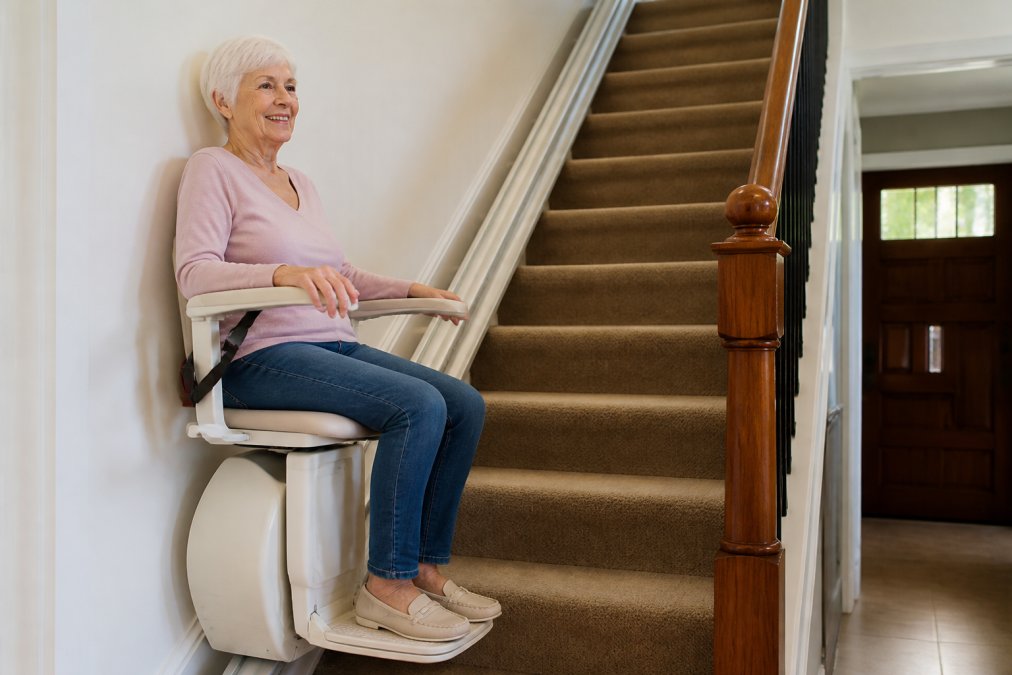
Navigating stairs with arthritis is not just tiring; the repetitive strain of lifting your body weight on inflamed joints can worsen symptoms and discourage you from moving freely within your own home. A stairlift is a motorized chair that carries you along a rail mounted to your staircase, eliminating the need to climb. By transporting you smoothly between floors, it spares your knees, hips, and ankles the impact of stepping, which is central to chronic pain management.
This guide from CT Stairlifts outlines what to look for when you are ready to regain access to every floor of your home. We focus on the specific features that make a difference for arthritic hands and the safety systems that provide peace of mind.
Key Features for Arthritis-Friendly Stairlifts
When shopping for stairlifts for seniors, the chair itself matters as much as the track. You are looking for a seat that minimizes pressure on sensitive joints and a mechanism that does not require a tight grip to operate.
An ergonomic seat is the first priority. Look for a model with a higher seat height to reduce the bend required at the knee and hip. Padded armrests provide a stable surface to push off from during transfers and a soft place to rest your arms. A power swivel feature is critical because it rotates the seat at the top of the stairs, allowing you to step off without twisting your torso or pivoting on a painful joint.
Beyond the seat, consider the footrest. It should fold up automatically and offer footrest adjustment to ensure your knees are not forced into an awkward angle. Finally, look for a seat belt mechanism that is easy to clip with one hand, as standard automotive buckles can be difficult for stiff fingers to manage.
Ergonomic Stairlift Controls for Limited Hand Dexterity
Stiffness and pain in the hands make twisting, pinching, and holding motions difficult. The controls on your stairlift must accommodate this reality, or the unit becomes unusable. This is where ergonomic stairlift controls become the deciding factor between a successful installation and a frustrating one.
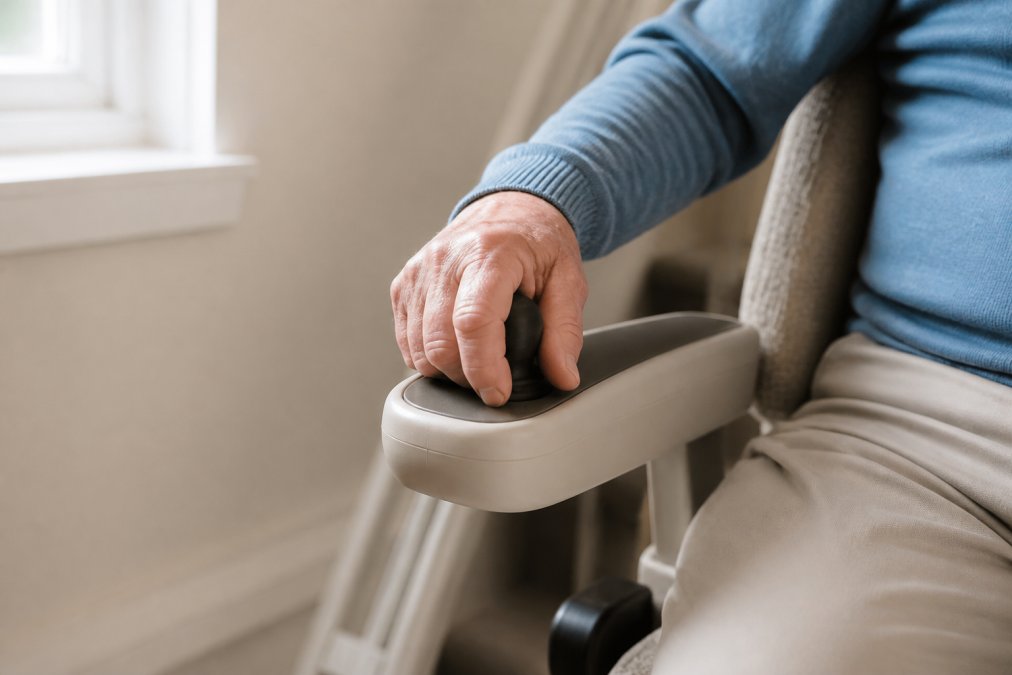
Most modern stairlifts use a joystick control rather than buttons, requiring a light touch and a simple directional push, not a fine pincer grip. For those with very limited strength, look for a model with remote operation capabilities. A key fob or remote allows a caregiver to call the stairlift to a specific floor or send it away after you have disembarked, reducing the need to manipulate controls at the landing stations.
If a control requires a strong push or a tight grasp, it will aggravate joint pain and could lead to you avoiding the stairlift altogether, which defeats the purpose of the investment.
Straight vs. Curved Stairlift Configurations
Your staircase geometry dictates which type of stairlift you need, and this is a primary factor in the overall cost and installation timeline. A straight staircase requires a straight rail mounted directly to the treads of the stairs.
For a straight staircase, a standard, off-the-shelf stairlift is usually sufficient. However, many homes have curved rails, landings, or odd angles. In these cases, a curved stairlift is required, featuring a rail custom-manufactured to match your staircase's exact measurements. This requires a home survey and a longer lead time for production.
| Staircase Type | Rail Configuration | Installation Time | Best For |
|---|---|---|---|
| Straight Staircase | Standard straight rail | Faster, often single visit | Homes with no turns or landings |
| Curved Staircase | Custom-bent rail | Requires survey and longer lead time | Homes with landings, curves, or spiral stairs |
| Narrow Staircase | Hinged track or compact rail | Varies by model | Tight spaces where a permanent rail is an obstruction |
If you have a straight staircase, the equipment is generally more readily available. If you have a curved staircase, you need a provider that offers custom solutions, as a standard unit will not fit the track configuration of your home.
Safety Features That Reduce Fall Risk and Support Independent Living
Safety is the primary reason families invest in a stairlift. The most critical safety feature is a battery backup. A stairlift operates on a rechargeable battery, not direct house current, so if the power goes out, the unit still functions, preventing you from being stranded between floors (osha.gov).
Beyond power, look for safety sensors along the rail that detect obstacles and stop the chair automatically to prevent a collision. An emergency stop button on the armrest is also standard, allowing you to halt the lift at any point if you feel unwell.
These features collectively support independent living by allowing you to use the stairs without a spotter. The swivel seat minimizes the risk of falling while trying to turn around at the top of the landing.
The Unique Angle: A Maintenance Checklist for Limited Mobility Users
Most guides stop at listing safety features, but a stairlift is only as safe as its ongoing maintenance. For a senior with arthritis, performing a safety check that requires bending, kneeling, or reaching awkwardly is a fall risk in itself. Here is a practical, mobility-friendly checklist you can perform from the seated position in the chair.
The Seated Safety Sweep (Perform Monthly):
- Visual Rail Check: While seated at the bottom of the stairs, look up the length of the rail. Scan for any visible debris, pet hair accumulation, or small objects that might have fallen onto the track. If you spot something, use a long-handled duster or a reacher-grabber tool to clear it, rather than bending over.
- Footrest Obstruction Test: Before your first ride of the day, use the remote to send the chair to the top of the stairs and back down. Watch the footrest as it travels to ensure it folds and unfolds cleanly without catching on anything.
- The 'Listen' Check: During that same remote run, listen carefully. A healthy stairlift motor runs with a consistent, low hum. If you hear any new clicking, grinding, or straining sounds, note it and report it to your provider during your next scheduled service visit.
- Armrest and Swivel Pressure Test: Sit in the chair and engage the manual swivel release (if you have a manual swivel). It should rotate smoothly with minimal effort. If it feels stiff, do not force it, this indicates a need for lubrication, which a technician should handle.
- Remote Control Functionality: With the chair parked, press the 'call' button on your remote. Verify the chair responds from a distance. This confirms the remote's battery is functional and the receiver is working, which is essential for caregiver operation.
By integrating this simple, seated maintenance routine into your monthly schedule, you take an active role in your own safety without compromising your physical limits, ensuring the safety features you rely on are always in optimal working condition.
Medicare Coverage for Home Mobility Aids: What Seniors Should Know
A common assumption is that Medicare will cover the cost of a stairlift because it is a medical necessity. Original Medicare (Part B) generally covers "Durable Medical Equipment" (DME) like wheelchairs and walkers, but a stairlift is typically classified as a home modification rather than portable medical equipment (medicare.gov).
Because the rail is permanently affixed to your house, Medicare does not usually consider it DME, so you should not expect Medicare coverage for home mobility aids under standard Part B benefits. Some Medicare Advantage (Part C) plans may offer supplemental benefits, but this varies widely by plan and state. Contact your plan administrator to verify your benefits.
While you cannot rely on Medicare, many states offer home modification assistance programs through Medicaid waivers or local Area Agencies on Aging. Additionally, a stairlift may be considered a deductible medical expense for tax purposes, provided you have a doctor's prescription documenting the need. Consult a tax professional and check the official IRS guidance for current rules.
The Unique Angle: A Practical Guide to the Medical Expense Tax Deduction
Most guides mention the tax deduction in passing, but few explain how to claim it. The IRS allows you to deduct unreimbursed medical expenses that exceed 7.5% of your Adjusted Gross Income (AGI) (irs.gov). For a senior with a moderate income, a stairlift purchase can often push them over this threshold.
Here is a step-by-step approach to navigating this process:
- Obtain a 'Letter of Medical Necessity' (LMN): This is the single most important document. Before you purchase, ask your physician to write a detailed letter stating that you have a diagnosed condition (e.g., osteoarthritis of the knee or hip) and that a stairlift is medically necessary to prevent falls and maintain mobility within your home. The letter should be on the doctor's letterhead and signed.
- Document the 'Medical vs. Personal' Purpose: The IRS distinguishes between a home modification that is medically necessary and one that adds to the home's value. A stairlift is generally considered a medical expense because it does not increase the resale value of your home. However, you must keep documentation that proves the primary purpose is medical, not aesthetic or convenience.
- Keep Itemized Invoices: Your invoice from the stairlift company must be itemized. It should clearly separate the cost of the equipment, the installation, and any necessary home modifications (like electrical work). Do not rely on a single lump-sum receipt.
- Track the 7.5% Threshold: The deduction only applies to the amount of your total medical expenses that exceeds 7.5% of your AGI. For example, if your AGI is $40,000, your deductible medical expenses must exceed $3,000 before you can claim any deduction. A stairlift costing $5,000 would likely make you eligible.
- Use IRS Form 1040, Schedule A: You will need to itemize your deductions using Schedule A. List your total medical expenses, including the stairlift, on line 1 of the form. Attach the LMN and a summary of the invoices to your tax return for your records, do not mail them unless requested.
Beyond the federal deduction, explore whether your state offers a property tax exemption for medical equipment. Some states exempt medically necessary home modifications from property tax assessments. Contact your local tax assessor's office to inquire about specific exemptions for mobility equipment, a layer of financial planning most stairlift guides overlook.
Conclusion
Choosing a stairlift is a significant step toward maintaining your independence and avoiding the physical toll of stairs on arthritic joints. Focus on the ergonomics of the seat and controls, the safety features like battery backup and sensors, and be realistic about the configuration your staircase requires.
At CT Stairlifts, we specialize in helping homeowners regain access to every floor of their home with solutions tailored to their specific needs. Our focus is on safe, convenient installation that fits your unique staircase geometry and physical requirements. Get started with CT Stairlifts and take the first step toward moving freely through your home again.
Frequently Asked Questions
Does Medicare pay for stair chair lifts for seniors?
Original Medicare (Part B) generally does not cover stairlifts because they are considered medical equipment that is not primarily for medical use in the home. However, some Medicare Advantage plans may offer supplemental benefits for home modifications. It is also worth checking state-specific programs or your local Area Agency on Aging for financial assistance. A tax deduction may be possible if the stairlift is deemed a medical necessity by a physician.
What should I look for in a stairlift if I have severe osteoarthritis?
Prioritize features that minimize joint strain and accommodate limited mobility. Look for a power swivel seat that rotates at the top of the stairs to reduce twisting of the hips and knees. A smooth start-stop technology prevents jarring movements that aggravate joint inflammation. Ergonomic controls, like a joystick or large rocker switch, are easier to operate with limited hand dexterity. Also consider the comfort of the padded armrests and the ease of the footrest adjustment.
How do stairlifts reduce joint strain for seniors?
Climbing stairs requires significant flexion and weight-bearing in the knees and hips, which directly aggravates joint inflammation and pain from osteoarthritis. A stairlift eliminates this repetitive strain by carrying your body weight along a track. This reduces the load on your joints, helping manage chronic pain and preventing the fatigue that often leads to a fall. It helps preserve your energy for other activities rather than exhausting yourself navigating the staircase.
Are there specific stairlift controls designed for limited hand dexterity?
Yes. Stairlift manufacturers offer several options to address limited hand dexterity. The most common is a joystick control, which requires minimal pressure and fine motor skill to push in the desired direction. Some models feature larger, rocker-style buttons that are easy to press with a palm or a closed fist. A remote operation option allows a caregiver to call or send the stairlift from the top or bottom landing, reducing the need for the user to manage the controls entirely.
This article was written using GrandRanker
Frequently Asked Questions
Q: Does Medicare pay for stair chair lifts for seniors?
A: Original Medicare (Part B) generally does not cover stairlifts because they are considered medical equipment that is not primarily for medical use in the home. However, some Medicare Advantage plans may offer supplemental benefits for home modifications. It is also worth checking state-specific programs or your local Area Agency on Aging for financial assistance. A tax deduction may be possible if the stairlift is deemed a medical necessity by a physician.
Q: What should I look for in a stairlift if I have severe osteoarthritis?
A: Prioritize features that minimize joint strain and accommodate limited mobility. Look for a power swivel seat that rotates at the top of the stairs to reduce twisting of the hips and knees. A smooth start-stop technology prevents jarring movements that aggravate joint inflammation. Ergonomic controls, like a joystick or large rocker switch, are easier to operate with limited hand dexterity. Also consider the comfort of the padded armrests and the ease of the footrest adjustment.
Q: How do stairlifts reduce joint strain for seniors?
A: Climbing stairs requires significant flexion and weight-bearing in the knees and hips, which directly aggravates joint inflammation and pain from osteoarthritis. A stairlift eliminates this repetitive strain by carrying your body weight along a track. This reduces the load on your joints, helping manage chronic pain and preventing the fatigue that often leads to a fall. It helps preserve your energy for other activities rather than exhausting yourself navigating the staircase.
Q: Are there specific stairlift controls designed for limited hand dexterity?
A: Yes. Stairlift manufacturers offer several options to address limited hand dexterity. The most common is a joystick control, which requires minimal pressure and fine motor skill to push in the desired direction. Some models feature larger, rocker-style buttons that are easy to press with a palm or a closed fist. A remote operation option allows a caregiver to call or send the stairlift from the top or bottom landing, reducing the need for the user to manage the controls entirely.