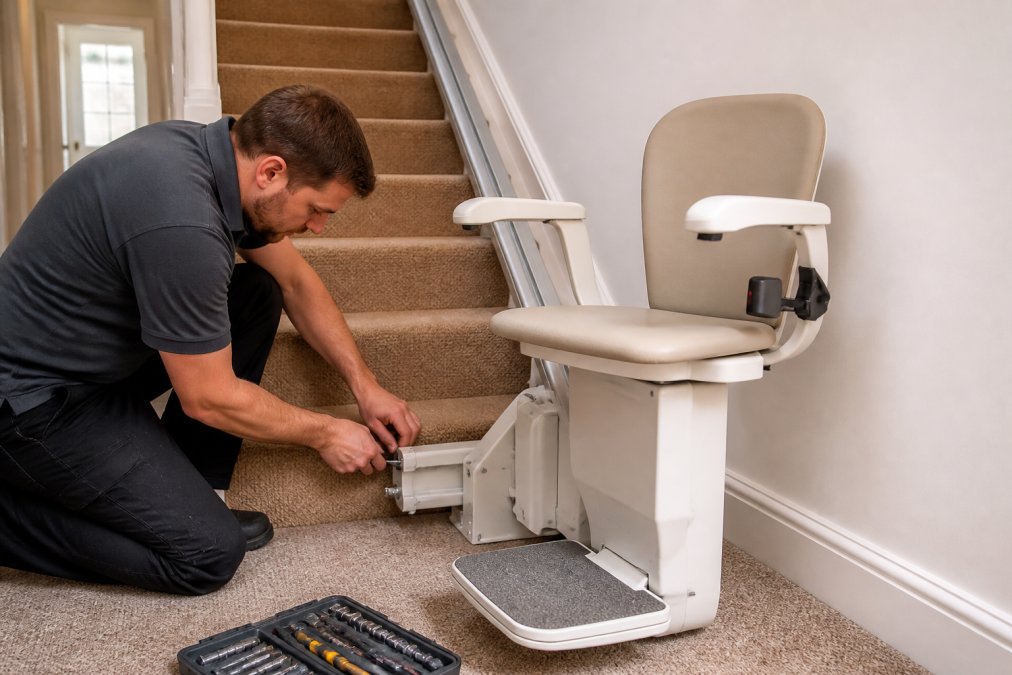
 ultimate-guide
Cost of Home Stairlift Installation 2026
Table of Contents
- What Affects Stairlift Installation Cost
- Straight vs. Curved Stairlift Cost Comparison
- Labor and Professional Installation Fees
- Stairlift Installation Process Explained
- Medicare Coverage for Home Modifications
- Financing, Payment Plans, and Tax Considerations
- Long-Term Costs: Maintenance and Service Contracts
- Conclusion
Last Updated: August 27, 2026
What Affects Stairlift Installation Cost
The cost of home stairlift installation 2026 depends on multiple factors that vary significantly between homes. Your staircase configuration is the primary driver of expenses. Straight staircases cost considerably less than curved installations that require custom track fabrication. The length of your rail, the angle of your stairs, and whether you have landings all factor into the final price.

Weight capacity and safety features add to the base cost. Standard models handle 250-300 pounds, but heavier-duty units with enhanced safety sensors, battery backup systems, and swivel seats cost more. Home modification requirements also affect total expenses. Some homes need structural reinforcement, wall repairs, or electrical work before installation can proceed. A site survey, which CT Stairlifts and most installers provide, identifies these needs upfront and typically takes 30-45 minutes.
Your choice between new, reconditioned, or refurbished units impacts cost significantly. New stairlifts come with full warranties and the latest safety technology. Reconditioned models have been professionally restored and often cost 30-50% less than new equipment (peer-reviewed research). Installation timeline and scheduling flexibility matter too, rush installations or weekend appointments typically cost more than standard scheduling.
Straight vs. Curved Stairlift Cost Comparison
Straight stairlifts are significantly less expensive than curved models because they use standard, pre-fabricated track. Installation is faster, labor requirements are lower, and most straight stairlifts can be installed in a single day.
Curved stairlifts require custom-built track that follows your staircase's exact dimensions and angles. This customization adds substantial cost to both equipment and labor. The track must be measured precisely, fabricated off-site, and installed with exacting accuracy. A curved installation typically takes 1-2 days and requires more skilled labor, especially when your staircase has multiple curves, landings, or unusual angles.
Maintenance costs also differ. Straight stairlifts have simpler mechanisms and typically cost less to service annually. Curved stairlifts have more complex track systems and may require specialized maintenance, increasing long-term service contract costs.
When evaluating the straight vs. curved decision, consider your home's layout and long-term needs. A straight stairlift is the most economical choice if your staircase configuration allows it. If your stairs curve, wind, or have multiple levels, a curved stairlift becomes necessary, and the investment reflects the engineering complexity required.
Labor and Professional Installation Fees
Professional installation labor represents a significant portion of the cost of home stairlift installation 2026. A straightforward installation on a simple straight staircase typically requires 2-4 hours of labor. More complex curved installations can take 8-12 hours or span multiple days.
Site preparation and structural assessment add to labor costs. The installer conducts a detailed site survey, identifies any modifications needed, and may coordinate with contractors if structural work is required. Electrical work is often included in professional installation fees but sometimes billed separately. The stairlift needs to be connected to a dedicated outlet, and some homes require electrical upgrades to support the system safely.
Testing and safety certification are non-negotiable parts of professional installation. The installer must verify that all safety sensors function correctly, test the emergency stop mechanism, check weight capacity, and ensure smooth operation throughout the full range of motion. Training on operation, maintenance, and emergency procedures is included with professional installation, ensuring safe, long-term use.
Stairlift Installation Process Explained
The stairlift installation process begins with a detailed site survey conducted by a qualified technician. During this 30-45 minute assessment, the installer measures your staircase, evaluates structural integrity, identifies obstacles, and determines whether modifications are needed.
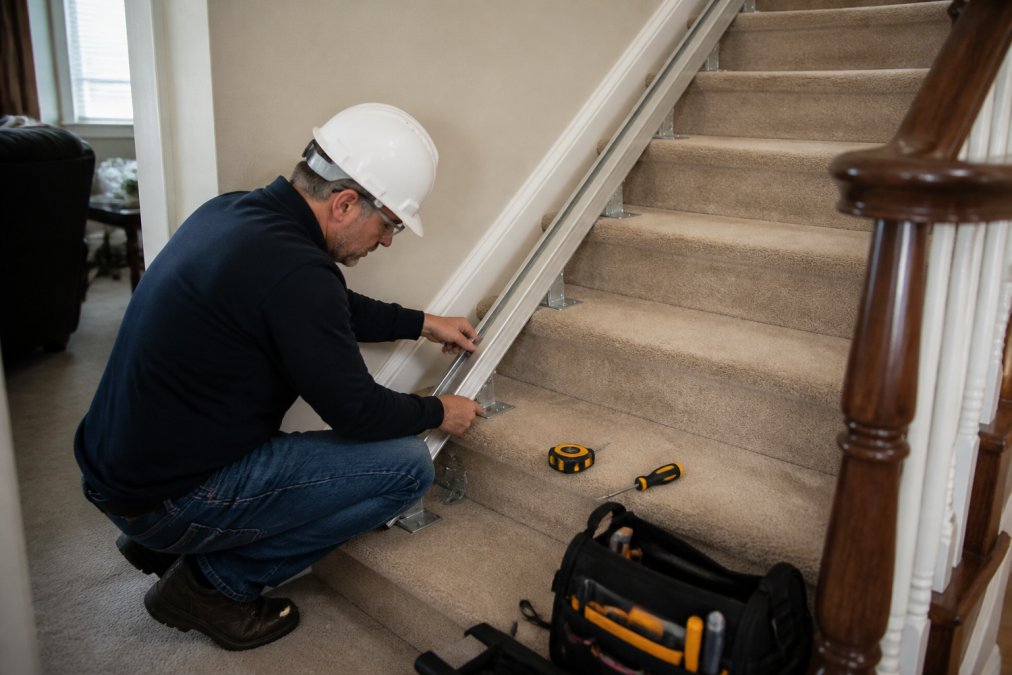
Once you approve the quote, the installer schedules installation at a time that works for your household. On installation day, the technician secures the rail to your staircase. For straight stairlifts, this involves anchoring the pre-fabricated track at precise intervals. For curved stairlifts, the custom track is positioned with exacting care.
The seat assembly and mechanical components are then mounted to the track. Safety sensors are calibrated and tested to confirm they stop the stairlift if an obstruction is detected. Electrical connection follows, with the stairlift connected to a dedicated outlet and the control system powered up. The technician tests the remote control, verifies buttons respond correctly, and checks the battery backup system.
Safety testing is comprehensive, with the installer operating the stairlift through its full range of motion, checking for smooth acceleration, consistent speed, and reliable stopping. The final step is training, where the technician shows you how to operate the stairlift, explains the control panel and remote, demonstrates the battery backup system, and reviews maintenance requirements.
Medicare Coverage for Home Modifications
Medicare coverage for home modifications is limited and highly specific. Medicare Part B covers durable medical equipment (DME) that your doctor prescribes as medically necessary. A stairlift may qualify as DME if your physician documents that it's essential for your mobility and safety due to a medical condition.
To qualify, your doctor must order the stairlift as part of your treatment plan, and it must be prescribed specifically for your use. Medicare then reviews the request and determines whether it meets coverage criteria. If approved, Medicare typically covers 80% of the approved amount after you meet your Part B deductible (cms.gov). You're responsible for the remaining 20% coinsurance and must use a Medicare-approved DME supplier.
Medicare does not cover installation labor or home modifications required to accommodate the stairlift. The approval timeline can be lengthy, often 4-8 weeks. Many people choose to purchase or rent a stairlift privately rather than wait for Medicare approval. If Medicare denies coverage, you have the right to appeal with additional medical documentation from your doctor.
Financing, Payment Plans, and Tax Considerations
Many stairlift providers offer financing options to make the cost of home stairlift installation 2026 more manageable. These plans typically spread payments over 12-60 months. Some financing programs are interest-free for a set period, often 12-24 months, if you pay the balance within that timeframe.
Credit unions often offer favorable financing rates for home modifications and medical equipment. Bank loans and home equity lines of credit are other options for financing larger expenses. Flexible spending accounts (FSAs) and health savings accounts (HSAs) may allow you to pay for stairlift installation with pre-tax dollars if the equipment qualifies as a medical expense.
Tax deductions for home modifications are limited. The IRS allows deductions for home modifications that are medically necessary and prescribed by a doctor, but only if the cost exceeds a threshold and you itemize deductions. Consult a tax professional to determine whether your stairlift installation qualifies.
Medicaid coverage varies by state. Some states cover stairlifts as durable medical equipment for eligible individuals, while others do not. Veterans may be eligible for benefits through the VA that cover home modifications including stairlifts. Charitable organizations and nonprofit foundations sometimes offer grants or assistance programs for seniors and people with disabilities who need home modifications.
Long-Term Costs: Maintenance and Service Contracts
The cost of home stairlift installation 2026 is only the beginning of your investment. Long-term maintenance and service contracts represent ongoing expenses that should factor into your total cost of ownership calculation.
Annual maintenance is essential for safe, reliable operation. Most manufacturers recommend professional servicing at least once per year. During a maintenance visit, the technician inspects the track for debris or damage, lubricates moving parts, tests all safety features, checks the battery backup system, and verifies smooth operation.
Maintenance contracts typically include scheduled maintenance visits and often include emergency repair coverage if the stairlift breaks down unexpectedly. Battery backup systems require periodic testing and eventual replacement. Most batteries last 3-5 years before losing the ability to hold a charge. Replacement battery packs cost several hundred dollars.
Track cleaning and lubrication are maintenance tasks you can perform yourself between professional visits. Regular cleaning prevents debris buildup that can interfere with smooth operation. Worn seat cushions, frayed straps, and damaged footrests are common wear items that eventually need replacement every 5-7 years depending on usage frequency (aarp.org).
Electrical issues become more common as stairlifts age. Some manufacturers offer extended warranty programs that cover parts and labor for 5-10 years. The total cost of ownership over 10 years includes the initial installation cost plus annual maintenance, battery replacement, wear-item replacements, and any emergency repairs.
The decision to install a stairlift is ultimately about maintaining your independence and safety while aging in place. Understanding the cost of home stairlift installation 2026, from the initial equipment and labor through long-term maintenance, allows you to make an informed decision that fits your budget and your home's needs. CT Stairlifts specializes in helping homeowners navigate this process, providing detailed site surveys, transparent pricing, professional installation, and ongoing maintenance support to ensure your stairlift operates safely and reliably for years to come.
Frequently Asked Questions
Q: Does Medicare cover the cost of stairlift installation?
A: Medicare generally does not cover stairlift installation as a standalone expense. However, if a stairlift is deemed medically necessary and prescribed by a physician as part of home accessibility modifications, it may qualify under Medicare Part B durable medical equipment coverage in limited circumstances. Coverage depends on your specific policy and medical documentation. Contact your Medicare provider directly to discuss your situation and what documentation may be required.
Q: What are the primary factors influencing stairlift installation costs?
A: Stairlift installation costs depend on staircase configuration (straight versus curved rail), rail length, custom track requirements, weight capacity needed, safety sensors and features, swivel seat options, folding footrest functionality, battery backup systems, and professional installation labor. Home modification needs, such as widening doorways or reinforcing structural elements, can also increase total expenses. A site survey helps determine which factors apply to your specific home.
Q: How do curved stairlift prices compare to straight stairlift installations?
A: Curved stairlifts typically cost more than straight models because they require custom track fabrication to match your staircase configuration. Straight rail stairlifts use standard components, making them less expensive to manufacture and install. The price difference reflects the complexity of engineering a curved track that fits your home's unique dimensions. Labor time for curved installations is usually longer, adding to total installation costs.
Q: What happens if the power goes out while I'm using the stairlift?
A: Modern stairlifts include battery backup systems that allow you to continue moving to the top or bottom of the stairs if power is lost. The backup battery ensures you are not stranded mid-staircase. Regular preventative maintenance and service agreements help ensure your battery backup functions properly. During your consultation, ask about battery capacity and how often the backup system should be tested.
Q: Can I rent a stairlift instead of buying one if I only need it temporarily?
A: Some providers offer refurbished or reconditioned stairlifts at reduced cost, and a few may have short-term rental or lease options for temporary recovery periods. Rental availability and terms vary by provider. Contact your local stairlift provider to ask about temporary solutions, lease-to-own arrangements, or buy-back programs if your needs change after installation.
Q: Are there tax deductions available for stairlift installation?
A: Home modifications for medical purposes, including stairlift installation, may qualify as medical expenses under Section 213(d) of the Internal Revenue Code if they are deemed medically necessary. You can deduct the cost if it exceeds the adjusted gross income threshold and you itemize deductions. Consult a tax professional to determine eligibility and proper documentation requirements for your specific situation.
Q: What is included in a stairlift service agreement?
A: Service agreements typically cover preventative maintenance, annual inspections, battery testing, safety sensor checks, and emergency repair calls. Some contracts include parts replacement and priority service response times. Review the warranty coverage and service agreement terms carefully before purchase to understand what is included, what costs extra, and how long coverage lasts.
This article was written using GrandRanker