 ultimate-guide
How to Fund Home Stairlifts: 2026 Guide to Costs & Aid
Table of Contents
- Understanding the Average Cost of Stairlift Installation
- Medicare Coverage for Home Modifications: What Is Covered?
- VA Grants for Home Improvements and Service-Connected Disabilities
- Stairlift Financing Options: Loans, Payment Plans, and More
- Step-by-Step: How to Fund Home Stairlifts with Public Programs
- Renting vs. Buying a Stairlift: Which Makes Financial Sense?
- Protecting Yourself from Stairlift Funding Scams
- Frequently Asked Questions
Last Updated: September 18, 2026
Understanding the Average Cost of Stairlift Installation
Stairlift pricing depends on stair configuration, model type, and installation complexity, so no single figure applies when you fund home stairlifts for every home. At CT Stairlifts, we tell homeowners the same thing: a straight staircase and a curved one are different projects, and quotes should reflect that.
Several variables drive the total:
- Stair shape: Straight runs are simpler to fit than curved or multi-landing staircases, which need custom rail fabrication.
- Drive type: Battery-powered units keep working during a power outage; some homeowners choose them specifically for that reason.
- Features: Folding rails, swivel seats, and perching options add to the base unit.
- Installation conditions: Narrow stairwells, doorways at the top or bottom, and structural quirks all affect labor.
Medicare Coverage for Home Modifications: What Is Covered?
Original Medicare generally does not pay for home modifications such as stairlifts, because the program treats them as home improvements rather than covered medical equipment. That distinction matters: a hospital bed ordered by a physician may qualify as durable medical equipment, but a stairlift bolted to your staircase usually does not.
VA Grants for Home Improvements and Service-Connected Disabilities
Veterans may access housing adaptation support through Department of Veterans Affairs programs, and eligibility hinges on service-connected disability status. The two main paths are a grant for adapting an existing home and a grant for constructing or modifying a home to accommodate a severe disability.
Key steps for VA funding:
- Confirm your service-connected disability status is documented.
- Contact your VA regional office to request the correct grant application.
- Obtain the required medical statement describing your mobility needs.
- Get contractor bids and submit them with your application.
- Wait for approval, then schedule installation.
- Keep every receipt for the final claim.
Stairlift Financing Options: Loans, Payment Plans, and More
When grants and insurance fall short, most families cover the gap with private funding. The main stairlift financing options fall into a few categories, each with different trade-offs.
| Option | Best For | Watch Out For |
|---|---|---|
| Home equity loan | Homeowners with built-up equity | Puts your home up as collateral |
| HELOC | Flexible, draw-as-needed funding | Variable interest rates |
| Reverse mortgage | Seniors 62+ with substantial equity | Reduces inheritance, high fees |
| Dealer payment plans | Smaller balances | Check whether interest is charged |
| Medical credit cards | Quick approval | Promotional rates can expire |
| Family contribution | Fastest, no interest | Set clear expectations |
Step-by-Step: How to Fund Home Stairlifts with Public Programs
Most guides list programs. Very few explain what actually happens between "I qualify" and "the stairlift is installed." This walkthrough covers the real sequence, the documents that stall applications, and the bureaucratic friction points that cause denials.
Step 1: Get a home safety assessment on paper
An occupational therapist (OT) or a qualified assessor documents why the stairs are unsafe and what modification is needed. This document is the backbone of nearly every application. Ask the OT to state the functional limitation in clinical language, for example, "patient cannot safely negotiate 13 steps to the only full bathroom due to balance deficits", rather than a general note that a stairlift "would help." Programs reject vague letters.
Step 2: Identify which programs you actually qualify for
The realistic funding sources fall into four buckets:
- Medicaid Home and Community-Based Services (HCBS) waivers. These are administered by states, and each state sets its own income and functional-eligibility rules. Some waivers cover environmental modifications including stairlifts; many do not. You must be Medicaid-eligible and meet the waiver's level-of-care criteria, which often means needing nursing-facility-level care but preferring to remain at home.
- VA housing grants. See the VA section above for the two grant paths and their service-connected disability requirement.
- State-funded accessibility or assistive-technology programs. Several states run assistive-technology loan or grant programs through their aging or vocational-rehabilitation agencies. Coverage and caps vary by state.
- Area Agencies on Aging and local nonprofit programs. These rarely fund a full stairlift but often cover a portion or connect you to a contractor.
Step 3: Gather the documents before you call
A common pattern is that applications stall because one document is missing. Assemble these first:
- Physician's letter or OT report stating medical necessity.
- Proof of income (recent tax return, Social Security award letter, or pay stubs).
- Proof of residency and identity.
- Two or more itemized contractor bids.
- A signed landlord permission letter if you rent.
Step 4: Apply before installation, always
Nearly every public program requires pre-approval. Installing first almost always means no reimbursement. If a contractor pressures you to install "while the application is pending," that is a red flag.
Step 5: Expect a wait, and follow up in writing
Waiver applications commonly take weeks to several months because they require a functional assessment and a level-of-care determination. Keep a log of every call: date, name of the person you spoke with, and what they said. A polite written follow-up referencing your application number moves files faster than phone tag.
Step 6: Keep every record in one folder
State waiver programs and state-funded accessibility programs vary widely, so confirm what your state offers through its official health or aging services department before assuming you are ineligible.
Renting vs. Buying a Stairlift: Which Makes Financial Sense?
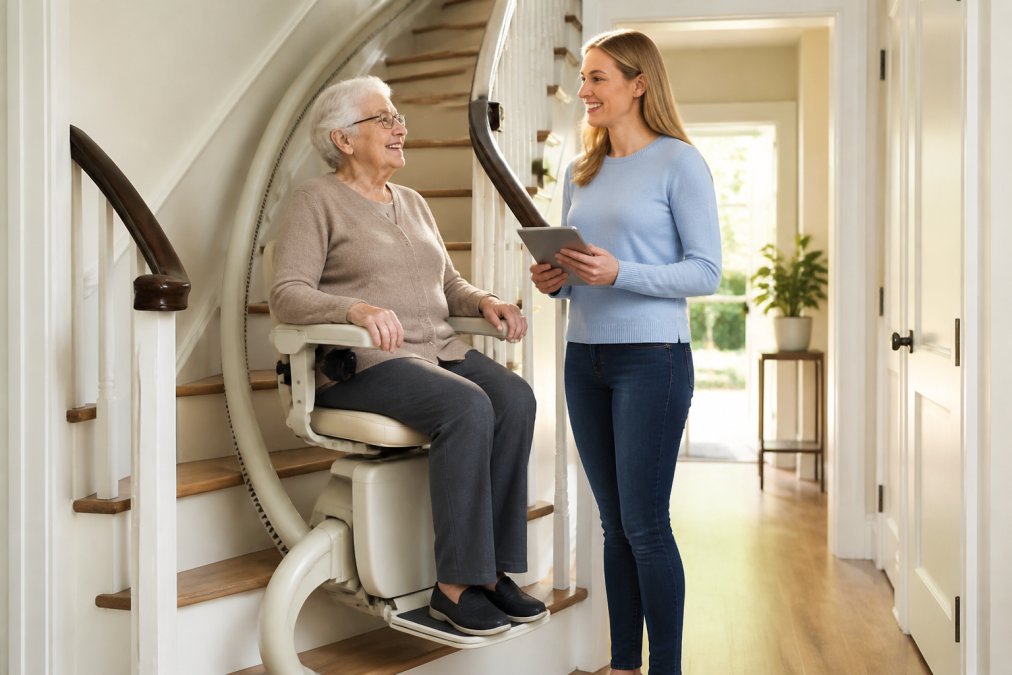
Most articles answer this question with "rent for short-term, buy for long-term" and stop. That is true but incomplete. The real decision depends on how the monthly rental cost compares to the purchase price over your expected period of need, plus what happens to the equipment when you are done with it.
The break-even calculation
Rentals are typically billed monthly, and the monthly rate usually includes installation, removal, and service. Purchases are a one-time cost that includes installation, with service either bundled for a warranty period or sold separately.
When renting is the better financial choice
- Short, defined recovery. A hip replacement, knee surgery, or a temporary injury with a known recovery window.
- Uncertainty about the home. If you may move within a year, renting avoids the resale problem.
- Rental housing. Some landlords allow a rental unit but not a permanent installation.
- You want service included. Rental agreements typically cover repairs and maintenance.
When buying is the better financial choice
- Progressive or permanent mobility decline. The need will not end.
- You plan to stay in the home. Spreading the cost over years of daily use lowers the effective monthly cost.
- You want the warranty and the tax treatment. A purchased stairlift installed as a medical necessity may qualify as a deductible medical expense; a rental payment may also qualify, but the documentation burden is similar.
The resale trap on curved stairs
Straight-rail units hold some resale value because the rail can be cut and reused. Custom curved rails are fabricated to one staircase and generally do not resell. If you have a curved staircase and expect a short need, renting is often the only way to avoid eating the full cost.
The hidden cost of moving instead
If family members are pushing you toward a one-story home, price the move honestly: realtor commissions, closing costs, moving expenses, and the disruption of leaving a familiar home. For many homeowners, the stairlift is the smaller financial and emotional disruption, but only if the need is expected to last.
Protecting Yourself from Stairlift Funding Scams
Red flags to watch for:
- Pressure to decide "today only"
- Requests for payment by gift card, wire, or cryptocurrency
- Callers claiming to represent Medicare or the VA and asking for your Social Security number
- "Guaranteed approval" offers with no credit or eligibility check
- Contractors who refuse to provide a written itemized quote
A second layer of protection is a written contract. It should list the equipment model, the installation scope, the warranty terms, the payment schedule, and the cancellation policy. Read it before signing, and never let a salesperson rush that step.
Frequently Asked Questions
Does Medicare pay for stair lifts for seniors?
Original Medicare (Part A and Part B) generally does not cover stairlifts because they are considered home modifications, not durable medical equipment. However, Medicare Advantage plans may offer supplemental benefits that include home accessibility modifications. Check your specific plan's evidence of coverage. If a stairlift is prescribed as medically necessary, a portion might be tax-deductible as a medical expense if it exceeds a certain percentage of your adjusted gross income.
How can I get financial assistance for a home stairlift?
Start by checking state Medicaid waiver programs, which may fund home modifications for eligible individuals. Veterans can explore VA grants like the Home Improvements and Structural Alterations (HISA) grant or the Specially Adapted Housing (SAH) grant. Non-profit organizations such as Rebuilding Together or local Area Agencies on Aging may also offer assistance. Finally, consider private financing options like home equity loans or medical financing companies to cover the average cost of stairlift installation.
Can I use a home equity loan to pay for mobility equipment?
Yes, a home equity loan or a Home Equity Line of Credit (HELOC) can be used to fund a stairlift. These loans use your home as collateral, often providing lower interest rates than personal loans. A Home Equity Conversion Mortgage (HECM), also known as a reverse mortgage, is another option for seniors 62 and older. However, these options involve credit approval and closing costs, so compare loan terms carefully before committing.
Are there government grants available for home accessibility modifications?
Yes, several federal and state programs offer grants. The VA provides grants for veterans with service-connected disabilities. State Medicaid waiver programs often cover home modifications for low-income individuals. The Department of Housing and Urban Development (HUD) funds some local programs through Community Development Block Grants. Eligibility criteria vary, so contact your state's Medicaid office or local housing authority to see what you qualify for.