 How-to
How Long Do Home Stairlifts Last: Lifespan, Care, and Replacement
Last Updated: November 21, 2026
Quick Summary
Most home stairlifts last between seven and fifteen years, depending on the model, how often it runs, and how well it is cared for. A well-maintained straight-rail unit often reaches the upper end of that range, while a heavily used curved-rail system with skipped service visits usually lands closer to the lower end.
- Straight-rail models are simpler with fewer custom parts, so many run reliably for a decade or more with basic care.
- Wipe the rail clean monthly and test safety sensors and the obstruction stop yourself.
- Book an annual technician inspection of the motor, gear, drive system, rail mounts, and battery.
- Stairlift batteries often need replacing after a few years, depending on use and charging habits.
- A lift past ten years old with an incomplete service record and a large repair bill is a replacement candidate.
Table of Contents
- How Long Do Home Stairlifts Last in Practice?
- What Affects the Lifespan of a Home Stairlift
- Stairlift Maintenance: A Practical Inspection Schedule
- How Long Does a Stairlift Battery Last?
- Signs a Stairlift Needs Replacing
- Stairlift Repair or Replacement: How to Decide
- Assessing a Used Stairlift and Checking Parts Availability
- Schedule a Stairlift Inspection with CT Stairlifts
- Frequently Asked Questions
How Long Do Home Stairlifts Last in Practice?
Most home stairlifts last between seven and fifteen years, depending on the model, how often it runs, and how well it is cared for. A well-maintained straight-rail unit often reaches the upper end of that range. A heavily used curved-rail system with skipped service visits usually lands closer to the lower end.
Lifespan is not a fixed number. It is an outcome you influence. The lift that lasts fifteen years is rarely the fanciest one. It is the one that got routine servicing, a fresh battery when needed, and small repairs before they became big ones.
Below, we break down what drives lifespan, how to inspect your lift, and when repair stops making sense.
Straight-Rail Versus Curved-Rail Lifespan
Straight-rail models are simpler, and that simplicity shows up in longevity. A straight rail has fewer custom parts, a lighter carriage, and less strain on the motor. Many straight-rail lifts run reliably for a decade or more with basic care.
Curved-rail models last well too, but they work harder. Each bend adds stress on the rail, the gear, and the drive system. Custom-bent rails also make replacement parts slower to source. That does not mean curved lifts are short-lived. It means the maintenance schedule matters more, not less.
If you are weighing rail types for your staircase, our guide to straight vs curved stairlifts walks through the full set of differences.
What Affects the Lifespan of a Home Stairlift
Five factors do most of the work in deciding how long a residential stairlift lasts:
- Frequency of use. A lift making a dozen trips a day wears faster than one used twice daily.
- Weight and load. Consistently carrying loads near the rated limit shortens motor and gear life.
- Installation quality. A rail set correctly on solid stair treads runs smoother and lasts longer.
- Service history. Regular servicing catches worn moving parts before they damage the rail or motor.
- Household conditions. Damp basements, wide temperature swings, and dusty air all speed up wear.
A common mistake is assuming a premium model needs less care. It does not. A quality system with a strong manufacturer behind it still depends on preventive maintenance to deliver its full useful life.
Stairlift Maintenance: A Practical Inspection Schedule
Stairlift maintenance is one of the most important factors you control over lifespan. A simple routine, done consistently, can help prevent breakdowns. A general inspection schedule is outlined below.
Monthly, by the homeowner:
- Wipe the rail clean of dust and grit
- Check that the seat swivels and locks smoothly
- Test the safety sensors and the obstruction stop
- Confirm the battery charger light shows a normal charge
- Listen for new noises, grinding, or uneven travel
Annually, by a service technician:
- Inspect the motor, gear, and drive system
- Check rail mounts and fasteners for looseness
- Test the battery under load and check charging output
- Lubricate moving parts per the manufacturer's spec
- Review the full safety system, including the seat belt and controls
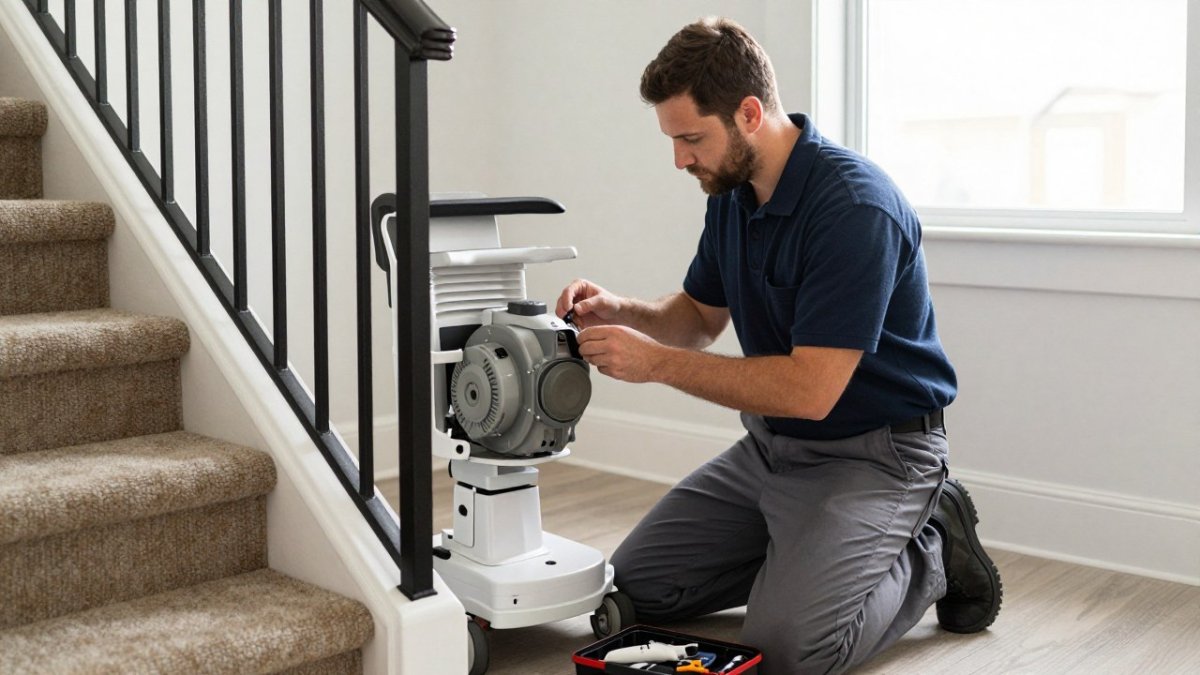
Watch out: skipping annual servicing to save money is the fastest way to turn a small worn part into a full motor or rail repair. For a deeper walkthrough, see our guide on how to maintain a home stairlift.
Here is the inspection schedule the article lays out, split between what you handle yourself and what a technician covers.
| Timing | Who | Tasks |
|---|---|---|
| Monthly | Homeowner | Wipe rail clean of dust and grit |
| Monthly | Homeowner | Check seat swivels and locks smoothly |
| Monthly | Homeowner | Test safety sensors and obstruction stop |
| Monthly | Homeowner | Confirm battery charger light shows normal charge |
| Monthly | Homeowner | Listen for new noises, grinding, uneven travel |
| Annually | Service technician | Inspect motor, gear, and drive system |
| Annually | Service technician | Check rail mounts and fasteners for looseness |
| Annually | Service technician | Test battery under load and charging output |
How Long Does a Stairlift Battery Last?
Stairlift batteries often need replacing after a few years of use, depending on how the lift is used and charged. Most residential lifts run on sealed rechargeable batteries that charge whenever the carriage sits at its parking point. Short trips and frequent parking keep the battery topped up.
Battery life drops when a lift sits unused for long stretches or charges poorly. A battery that drains fast, charges slowly, or leaves the lift sluggish on the rail is telling you something. Replace it before it fails mid-flight.
If you want to get the most from yours, our article on maintaining stairlift battery life covers charging habits and replacement timing in detail.
Signs a Stairlift Needs Replacing
Repair is normal. Replacement becomes the question when problems stack up. Watch for these warning signs:
- The lift stops or stalls partway up the stairs
- The motor sounds strained or runs hot
- The rail shows visible wear, rust, or loose mounting
- Repairs are needed more than once a year
- Parts take weeks to arrive, or are no longer made
- The controls or safety sensors act unpredictably
Any single sign is not a verdict. Several together usually point toward a lift nearing the end of its useful life. Our list of common stairlift repair issues explains which problems tend to signal deeper wear.
Stairlift Repair or Replacement: How to Decide
The repair-or-replace call comes down to three questions: what the repair costs, how old the lift is, and whether parts are still available. Framing the decision as a lifetime-cost comparison, rather than a single repair bill, can produce a clearer answer.
Start with the repair estimate in writing. Ask the technician to itemize parts and labor separately. A single worn component, a seat swivel, a limit switch, a battery, is usually a straightforward repair on a lift under ten years old.
Then compare against replacement on a per-year basis. A common pattern is to divide the quoted repair cost by the number of years you reasonably expect the lift to keep running after the fix.
Check parts availability before you commit to either path. A repair is only as good as the supply of replacement parts behind it.
Weigh the recurring service cost, not just the one-time bill. Older lifts often need more frequent service visits.
Use age and service history as tiebreakers. As a general rule, a lift past ten years old with an incomplete service record and a repair bill approaching a large share of replacement cost is a replacement candidate. A younger lift with annual servicing and a single failed part is a clear repair.
Watch out: approving a repair on a discontinued model without first confirming the part is actually available can turn a modest fix into a dead-end expense.
Repair and replacement costs vary widely by model, rail type, and part, so ask for a written estimate and compare it against the age and service history of your lift before deciding.
Assessing a Used Stairlift and Checking Parts Availability
Inheriting a stairlift or buying a used one can work well, but only if you verify a few things before you rely on it.
Step 1: Identify the manufacturer and model. Find the data plate or serial label on the carriage or rail. Record the manufacturer, model number, and manufacture date.
Step 2: Confirm the maker still supports the model. Contact the manufacturer or an authorized dealer and ask three questions: Is this model still supported? Are replacement batteries and drive components in stock? What is the typical lead time? A used lift that fits your staircase and has parts support can serve for years.
Step 3: Review the service history. Ask for documentation of annual servicing. A lift with a documented service record is a far safer bet than one with none.
Step 4: Inspect the hardware. Check the rail for rust, bends, or loose mounting brackets. Look at the carriage for uneven wear on the wheels or gear.
Step 5: Test the battery and charging system. A used battery is the most likely immediate expense.
Step 6: Test every safety system. Run the obstruction sensor, the seat belt, the swivel lock, and the emergency stop.
Step 7: Have a technician inspect before you rely on it. A professional inspection of the rail, motor, battery, and safety sensors is the final gate.
Watch out: a used lift that is cheap to acquire but has no parts support can cost more over two years than a supported unit bought at a higher price.
If you are weighing a used unit against a new installation, our guide to straight vs curved stairlifts explains how rail type affects both parts availability and long-term service cost.
Schedule a Stairlift Inspection with CT Stairlifts
A stairlift that stops working, or one you are unsure about, deserves a professional look. CT Stairlifts provides specialized stairlift installations designed to help homeowners regain access to every floor of their home.
If you are deciding whether to repair, replace, or simply check an aging lift, an annual safety inspection is the place to start. Our team can assess the rail, motor, battery, and safety system, and give you a straight answer on what your lift needs next. Understanding the benefits of annual safety inspections is a good first step before you book.
How long your home stairlifts last comes down to care, use, and timely repairs. When you are ready for a professional assessment, CT Stairlifts offers specialized installation and tailored support to keep every floor of your home within reach. Get started with CT Stairlifts and keep your lift running safely for years to come.
Frequently Asked Questions
How long do home stairlifts typically last?
Lifespans vary by model and maintenance, and well-maintained units tend to last considerably longer than poorly maintained ones. Straight-rail models tend to outlast curved-rail units because there are fewer custom parts to wear or replace. Frequency of use, routine servicing, and whether the battery has been replaced on schedule all shift that range. A lift used twice a day by one person and serviced annually will usually outlast one used heavily by two people with no service history.
How often should a stairlift be serviced?
Annual servicing is the standard recommendation for a residential stairlift, with a simple owner check monthly. Each month, run the lift through a full trip, listen for new noises, check that the seat swivels and locks, and confirm the charging light is on when parked. Every year, a service technician should inspect the rail, motor, controls, safety sensors, and battery. If the lift gets heavy daily use or sits on an outdoor or unheated staircase, ask about a twice-yearly inspection instead.
Can a stairlift be repaired instead of replaced?
Often, yes. Batteries, chargers, seat swivels, safety sensors, and control boards are replaceable parts, and a single fault on an otherwise sound lift is usually worth fixing. Replacement makes more sense when repairs pile up, when the manufacturer no longer supplies parts for that model, or when the rail and motor both show wear. Ask for a written repair estimate and compare it against the cost of a new unit before deciding, since the right answer depends on the age and condition of your specific lift.
How long does a stairlift battery last?
Stairlift batteries typically need replacing after some years of use, and their life depends on how the lift is used and charged. The lift charges while parked at either end of the rail, so leaving it off the charging point shortens battery life. Warning signs include slower travel, a lift that stops partway, or a charger that stays warm with no charge gained. Replacement batteries are a routine service item, and having one swapped before it fails avoids being stranded mid-flight during a power outage.