 How-to
Can a Stairlift Run on an Extension Cord? What to Know
Last Updated: November 7, 2026
Quick Summary
No, you should not assume can a stairlift run on an extension cord, because stairlifts are generally designed to plug directly into a wall outlet and an extension cord is not part of that design. A cord adds a trip hazard on the stairs and can overheat under the steady draw of a charging unit, so always follow the manufacturer's guidance for your specific model.
- A standard stairlift typically runs on 120 volts through a grounded, three-prong wall outlet in the US.
- A stairlift runs on a low-voltage battery that the charger tops up when the carriage is docked.
- A charged stairlift keeps working during a power outage for a limited number of trips.
- For temporary use, keep the cord run under five feet and never coil it while in use.
- When the outlet is too far away, the fix is a new outlet added by an electrician, not a longer cord.
Table of Contents
- Why a Stairlift Extension Cord Is a Bad Idea
- Stairlift Electrical Requirements: Voltage, Outlet Type, and Circuit Needs
- Does a Stairlift Need a Dedicated Circuit?
- Stairlift Battery Charging: How the Unit Powers Itself
- Stairlift Power Outage: What Happens When the Grid Goes Down
- Safe Temporary Setup Checklist for a Stairlift Extension Cord
- What to Do If the Outlet Is Too Far Away
- Schedule a Professional Electrical Assessment for Your Stairlift
- Frequently Asked Questions
Why a Stairlift Extension Cord Is a Bad Idea
Can a stairlift run on an extension cord? The short answer is no.
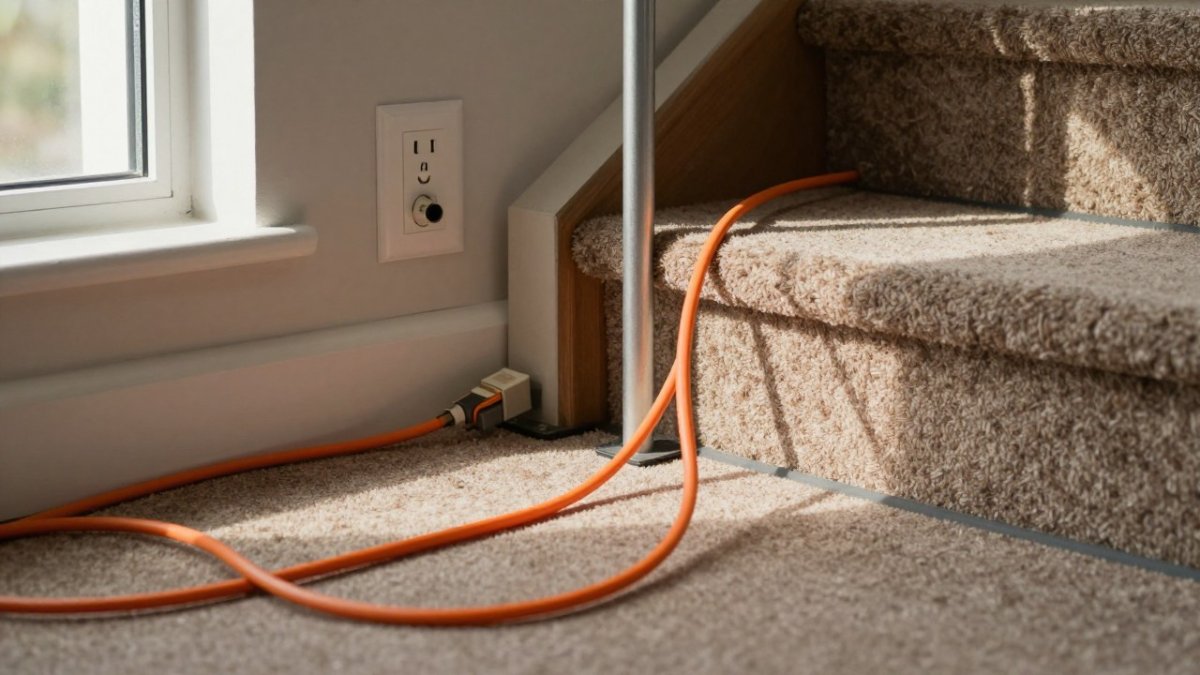
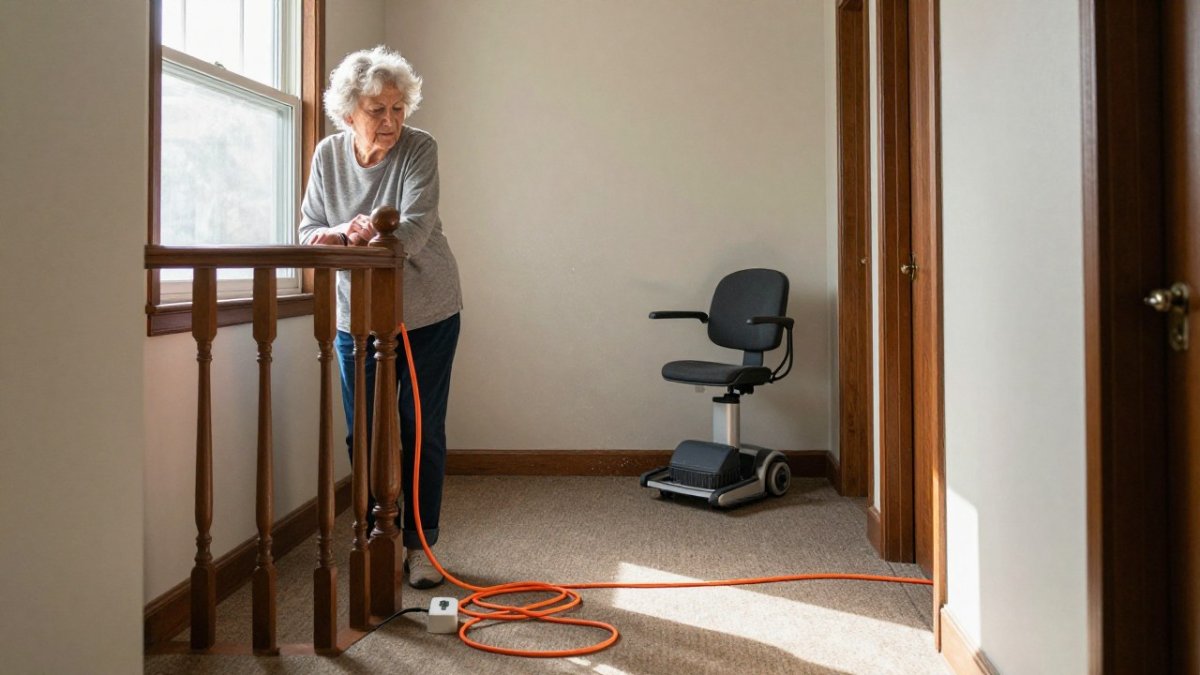
An extension cord turns a fixed electrical connection into a loose one. That matters on a staircase, where the cord crosses the exact path a person walks.
Here is what goes wrong most often:
- The cord lies across the top or bottom landing, right where a person steps off
- The plug works loose over time and the charger cuts in and out
- A light-duty cord carries more current than its wires are rated for
- The cord gets pinched behind the rail or under the carriage
Any one of these can stop the lift when someone is on it. That is the real risk, not a blown fuse.
Stairlift Electrical Requirements: Voltage, Outlet Type, and Circuit Needs
A standard stairlift typically runs on ordinary household current. In the United States, that usually means 120 volts through a grounded, three-prong wall outlet. Power draw varies by model, so check your manufacturer's documentation.
The details that matter:
- Voltage: 120 V, standard household voltage
- Outlet type: grounded three-prong receptacle
- Power supply: a charger that converts wall current to low-voltage DC for the battery
- Current draw: low, because the unit charges rather than runs on mains power
Manufacturer instructions set the exact outlet location and cord length for each model. Follow those, not a general rule of thumb. Our team can walk you through the full breakdown of stairlift electrical requirements for home if you want the specifics before installation day.
How to Verify a Cord Against Your Stairlift Documentation
Before anyone reaches for an extension cord, the stairlift manual is the authority on what the charger is designed to accept.
Use those numbers to check a cord, not a guess:
- Voltage match. The cord and any adapter must be rated for 120 V. A cord marked only for a different voltage is not suitable.
- Current or wattage rating. Find the charger's input current in amps or its wattage on the label, then confirm the cord's rating meets or exceeds it. A cord rated for less than the charger draws will run warm.
- Grounding. The cord must carry a ground prong through to the outlet. Never use a two-prong adapter or a cheater plug to force a grounded plug into an ungrounded outlet.
- Length and gauge. A longer, thinner cord drops more voltage and heats up more. If the manual gives a maximum cord length, treat it as a ceiling, not a target.
- Condition. A cord with cracked insulation, a loose plug, or a repaired end is not suitable regardless of its rating.
Watch out: if the manual is silent on extension cords, that silence is not permission.
A common pattern is that the charger's draw is small enough that a heavy-duty grounded cord rated for the load will carry it without stress, but the trip and connection risks remain.
Here are the core electrical facts to check before plugging in a stairlift.
| Item | Value | Note |
|---|---|---|
| Voltage | 120 V | Standard household voltage in the US |
| Outlet type | Grounded three-prong receptacle | Never use a two-prong adapter |
| Power supply | Charger converts wall current to low-voltage DC | Feeds the battery, not the motor directly |
| Current draw | Low | Unit charges rather than runs on mains power |
| Cord rating | Must meet or exceed charger's amps or wattage | A lower-rated cord runs warm |
| Grounding | Ground prong carried through to outlet | Cheater plugs are not suitable |
| Length and gauge | Longer, thinner cords drop voltage and heat up | Manual's maximum length is a ceiling |
| Condition | No cracks, loose plug, or repaired end | Any of these makes a cord unsuitable |
Does a Stairlift Need a Dedicated Circuit?
Many stairlifts charge on low current and may share a circuit with nearby outlets, but requirements depend on the model.
That said, a dedicated outlet is worth having. It keeps the charger from sharing power with a space heater, a window air conditioner, or a power tool in the garage.
Ask the installer to confirm the circuit has spare capacity. Our guide on whether stairlifts require a home electrical upgrade covers how to check before you commit.
Stairlift Battery Charging: How the Unit Powers Itself
A stairlift does not run on wall power while it moves. It runs on a low-voltage battery, and the charger tops that battery up whenever the carriage sits at its parking point.
This design is why a power outage does not strand anyone mid-flight. The battery holds enough charge for several trips.
A few practical points:
- Keep the carriage parked at the charge point when not in use
- Wipe the charging contacts clean if you notice sluggish charging
- Watch for a charger that runs warm or a battery that drains fast
If you are weighing whether backup power is worth it, our article on whether a battery backup is necessary for stairlifts explains how the unit stays powered and what to expect.
Stairlift Power Outage: What Happens When the Grid Goes Down
A charged stairlift keeps working during a power outage. The battery carries the carriage up and down for a limited number of trips, so a short outage usually goes unnoticed.
The catch is that the charger stops while the power is out. Once the battery drains, the lift stops until the grid returns.
Signs the battery needs attention:
- The lift slows down near the end of a trip
- The carriage beeps or flashes a warning
- The unit stops short of the landing
Our guide on how to maintain your stairlift battery life covers the habits that keep the battery ready for an outage.
Safe Temporary Setup Checklist for a Stairlift Extension Cord
Sometimes a short-term situation calls for a temporary connection. A move, a renovation, or a waiting period before a new outlet goes in can leave the lift without a nearby socket. In those cases, treat the setup as a stopgap and follow every step.
- Confirm the manufacturer allows a temporary cord for your model
- Use a heavy-duty grounded cord rated for the charger's current
- Keep the cord run under five feet and never coil it while in use
- Route the cord along the wall, never across the stair treads
- Tape the cord down or use a cord cover on any walking surface
- Check the plug and cord for heat, cracks, or fraying each week
- Unplug the cord when the lift is not charging
- Replace the setup with a permanent outlet as soon as possible
Watch out: a cord that crosses the stairs is a fall risk for everyone in the home, not just the person using the lift. If the run cannot stay clear of the walking path, stop and call an electrician instead.
Temporary Versus Permanent Use
The conflicting advice online usually comes down to time frame. A cord used for a few days while an outlet is being installed is a different risk than a cord left in place for months. For ongoing use, a nearby wall outlet is preferable because it removes the loose connection, the trip hazard, and the heat risk all at once.
Troubleshooting: Is It the Cord or the Lift?
When charging slows or stops, the cord is only one suspect. Work through the possibilities in order so you do not replace a cord that was never the problem:
- The outlet. Plug a lamp or phone charger into the same outlet. If it does not work, the outlet or the circuit is the issue, not the cord.
- The cord connection. Check that the plug sits firmly in the outlet and in the charger, and that the cord is not warm at either end. A loose or warm connection points to the cord or the outlet.
- The charger. Confirm the charger's indicator light behaves as the manual describes. No light or a flickering light can mean the charger itself has failed.
- The charging contacts. Wipe the contacts on the carriage and the rail with a dry cloth. Dust, pet hair, and carpet fibers are common causes of intermittent charging.
- The battery. A battery that drains faster than it used to, or a lift that slows near the end of a trip, points to the battery rather than the cord.
If the lift stops mid-trip, beeps a warning, or fails to charge on a known-good outlet with a known-good cord, stop using it and call for service. Continuing to run a lift with a charging fault can leave someone stranded on the stairs.
What to Do If the Outlet Is Too Far Away
When the nearest outlet sits too far from the rail, the fix is a new outlet, not a longer cord. An electrician can add a grounded receptacle near the base or top of the stairs, often tapping an existing circuit. The run is usually short and the work is routine.
Options, from simplest to most involved:
- Add an outlet near the rail. Often the cleanest fix.
- Move the charger's parking point. Some models allow the charge point at either end of the rail.
- Use a temporary heavy-duty cord. Only as a stopgap, with the checklist above.
- Upgrade the panel. Needed only if the circuit has no spare capacity.
Avoid running a cord through a doorway, under a rug, or through a wall, as these can hide damage and raise fire risk.
Schedule a Professional Electrical Assessment for Your Stairlift
The safest path is to have the outlet checked before the lift goes in. A licensed installer confirms the voltage, the outlet type, and the circuit load, then flags anything that needs an electrician.
You can contact CT Stairlifts to discuss your outlet situation before installation day.
A stairlift should give you back every floor of your home, not add a new worry at the top of the stairs.
Frequently Asked Questions
Can you plug a stairlift into an extension cord?
Manufacturers generally advise against using an extension cord with a stairlift. The motor draws a high current during operation, and a standard household extension cord may not be rated to handle that load, leading to overheating or voltage drop. A dedicated wall outlet near the stairlift is the safe choice. If an outlet is not nearby, a qualified electrician can install one rather than relying on an extension cord.
Do stairlifts need a dedicated electrical circuit?
Most stairlift manufacturers recommend a dedicated circuit for the charging unit to prevent overloading the circuit and to ensure consistent charging. A dedicated circuit means the outlet is wired directly to the breaker panel and not shared with other appliances. Check your model's installation manual for specific requirements, as some units may allow a shared circuit if the load is low.
Will a stairlift work during a power outage?
Yes, most stairlifts run on battery power and will continue to operate for a limited number of trips during a power outage. The battery is continuously charged when the stairlift is parked at either end of the rail. However, if the outage lasts several days, the battery may deplete. After power returns, the battery recharges automatically. Keep the stairlift parked on its charging contacts when not in use.
What should I do if my stairlift is not charging?
First, confirm the stairlift is parked correctly so the charging contacts meet. Check that the outlet has power and the charger is plugged in securely. Inspect the charging contacts for dirt or damage and clean them gently. If the battery still does not charge, contact a qualified technician. Do not attempt to use an extension cord as a workaround, as this can worsen the issue or create a safety hazard.