 how-to
Do Stairlifts Require a Home Electrical Upgrade?
Table of Contents
- Do Stairlifts Require a Home Electrical Upgrade? The Short Answer
- Stairlift Electrical Requirements: What Most Homes Already Have
- Is a Stairlift Dedicated Circuit Necessary?
- Stairlift Charging Outlet Location: Where It Should Go
- Preparing Your Home for Stairlift Installation: An Electrical Checklist
- When an Electrical Upgrade Is Actually Needed
- Power Outages, Charging, and Safe Operation
- Conclusion
- Frequently Asked Questions
Last Updated: October 15, 2026
Do Stairlifts Require a Home Electrical Upgrade? The Short Answer
For most homes, the answer to "do stairlifts require a home electrical upgrade" is no.
At CT Stairlifts, we walk Connecticut homeowners through this every week, and the vast majority of staircases need nothing more than an outlet within reach of the rail.
Because the lift runs on a battery, not wall current, it keeps working during a power outage, the biggest safety feature most buyers never ask about.
Below: what your home already has, when a real upgrade is needed, and how to check your setup safely.
Stairlift Electrical Requirements: What Most Homes Already Have
A stairlift needs three things: a working outlet, standard household voltage, and a grounded connection. Most modern homes already have all three near the staircase.
The lift draws very little power. According to the U.S. Department of Energy's home electricity guidance, common household appliances and small motorized devices draw far less current than most people assume, and a stairlift's continuous draw while charging is modest.
Here is what the average setup looks like:
- Voltage: 120V, the standard for household outlets in the U.S.
- Outlet type: A grounded three-prong outlet is preferred
- Power draw: Low, comparable to a small appliance on standby
Voltage, Outlets, and Battery Charging
The charging system is simple: when the lift parks at either end of the rail, it connects to a charging point and the onboard battery tops up.
The outlet's job is to keep the battery charged, not to power the ride, which is why the lift still works when the power goes out, at least for a few trips.
Most homes meet these requirements without changes. The real question is whether an outlet sits close enough to the rail.
Is a Stairlift Dedicated Circuit Necessary?
No, a stairlift dedicated circuit is almost never required. Its low, intermittent draw can share an existing circuit without overloading it.
A dedicated circuit means one breaker serves one device, electricians reserve those for high-draw appliances like dryers, ovens, and space heaters.
When would someone need one? Rarely, only if the circuit is already near its limit or local code requires it.
Stairlift Charging Outlet Location: Where It Should Go
The charging outlet should sit near one end of the staircase, ideally the bottom landing, within reach of the rail's charging point, where the lift parks most often and the cord stays out of the way.
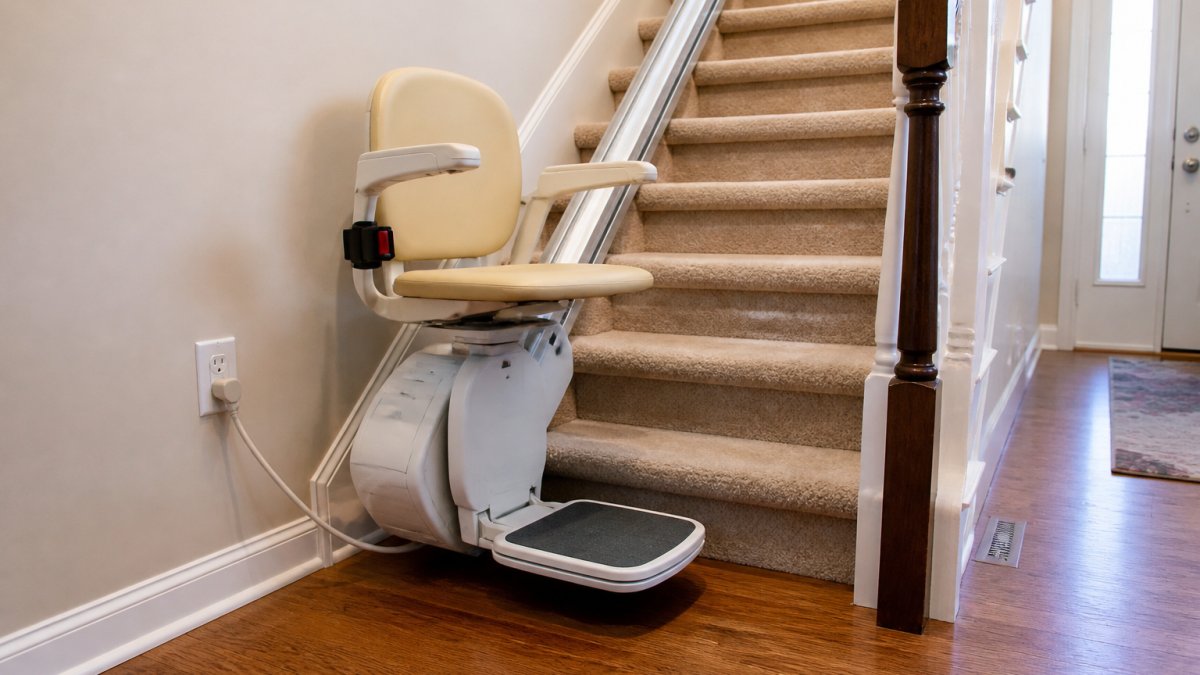
Placement matters: the cord must reach without stretching across a walkway or creating a trip hazard.
A few practical placement notes:
- Bottom landing is usually best, since the lift rests there when not in use
- Keep the cord tucked along the wall, not draped across the floor
- Avoid outlets directly behind where the chair parks, if space is tight
If your staircase has no outlet nearby, an electrician can add one, a small job in most cases, not a full rewiring project.
Preparing Your Home for Stairlift Installation: An Electrical Checklist
Getting ready is mostly about checking, not changing. A short walkthrough before the installer arrives avoids surprises.
What to Check Before Installation Day
Run through this list a few days ahead:
- Confirm at least one working outlet near the staircase
- Test the outlet with a small device to confirm it has power
- Check that the outlet is grounded (three-prong, or tested with a plug tester)
Most of these take minutes. The goal is to catch a small issue before it becomes an installation-day delay.
The U.S. Consumer Product Safety Commission's electrical safety guidance recommends testing outlets and watching for warning signs like warm faceplates or frequent breaker trips. If you spot any of those, have an electrician look before installation.
When an Electrical Upgrade Is Actually Needed
An upgrade is needed when existing wiring cannot safely support even a low-draw device, or when the outlet setup fails basic safety checks. What most guides skip is the practical middle ground: the common scenarios homeowners face, and how to tell which one you are in.
A Simple Decision Path
Work through these questions in order. Stop at the first one that describes your situation.
- Is there a working, grounded outlet within cord-reach of where the rail will end? If yes, you almost certainly need no electrical work. Proceed to installation.
- Is there an outlet nearby, but it is ungrounded (two-prong) or fails a plug-tester check? You likely need a minor fix, grounding the existing receptacle or replacing it with a grounded one on an existing grounded circuit.
- Is there no outlet near the staircase at all? You need a new receptacle run from an existing circuit, which is a small job in most homes but not a do-it-yourself one.
- Does the circuit trip, feel warm, or share a breaker with a high-draw appliance like a space heater, freezer, or window air conditioner? Get an electrician's assessment before installation. The lift itself is low-draw, but you do not want to add any load to a circuit that is already stressed.
- Does the home have knob-and-tube wiring, a fuse box that trips often, or ungrounded outlets throughout? This is the only scenario that can approach a real upgrade. It still does not automatically block a stairlift, but the plan changes and the timeline stretches.
What Each Scenario Typically Costs and How Long It Takes
Exact figures vary by region, panel condition, and wire distance, so treat these as planning ranges. Most electricians charge by the hour plus materials, and many give a flat price for a simple receptacle addition.
| Scenario | Typical Work | Typical Time | Typical Cost Range |
|---|---|---|---|
| Working grounded outlet already present | None | 0 | $0 |
| Ungrounded outlet on a grounded circuit | Replace receptacle, verify ground | Under 1 hour | Often under $200 |
| No outlet near stairs, short run from existing circuit | Add receptacle, fish wire, terminate | 2-4 hours | Commonly $250-$600 |
| Circuit near capacity or shared with high-draw load | Assess load, possibly add a circuit | Half day or more | Commonly $500-$1,500+ |
| Older wiring or panel concerns | Full evaluation, possible remediation | Multi-day | Highly variable; get a written estimate |
A written estimate from a licensed electrician is the only number that matters for your home.
What You Can Safely Check Yourself
The U.S. Consumer Product Safety Commission's electrical safety guidance recommends testing outlets and watching for warning signs like warm faceplates or frequent breaker trips. You can do all of the following without opening any electrical equipment:
- Plug a small device into the outlet to confirm it has power.
- Use a plug-in receptacle tester (available at any hardware store) to confirm grounding and correct wiring.
- Note what else turns off when you flip the breaker that controls that outlet.
When to Stop and Call an Electrician
Stop and call a licensed electrician if any of the following is true:
- The outlet is warm, discolored, or smells odd.
- The breaker trips repeatedly.
- You see exposed or cloth-covered wiring, or a fuse box instead of a breaker panel.
Do not remove a faceplate, open a panel, or add a receptacle yourself. The lift installer is not typically licensed for electrical work beyond plugging the unit in, and mixing the two jobs turns small problems into expensive ones.
Do not ignore an outlet that feels warm, smells odd, or trips the breaker repeatedly. Those are warning signs of a wiring problem, and installing any device on that circuit before it is checked can create a real hazard.
The pattern is clear. Most homes land in the first row of the table. A smaller number need a quick fix. Very few need anything close to a full electrical upgrade, and the ones that do usually already knew their wiring was old.
Power Outages, Charging, and Safe Operation
A stairlift keeps working during a power outage because it runs on its battery, not wall current, reassuring for anyone worried about getting stuck mid-ride. Here is how charging works, how many trips you get, and what to do when the lift stops charging.
How the Charging System Works
When the lift parks at either end of the rail, a charging contact on the carriage meets a contact on the rail and the onboard battery tops up automatically. You never plug it in by hand; the outlet's only job is keeping that battery topped off.
A few practical details:
- The lift charges whenever it is parked at a charging point, whether that is the top or bottom of the rail.
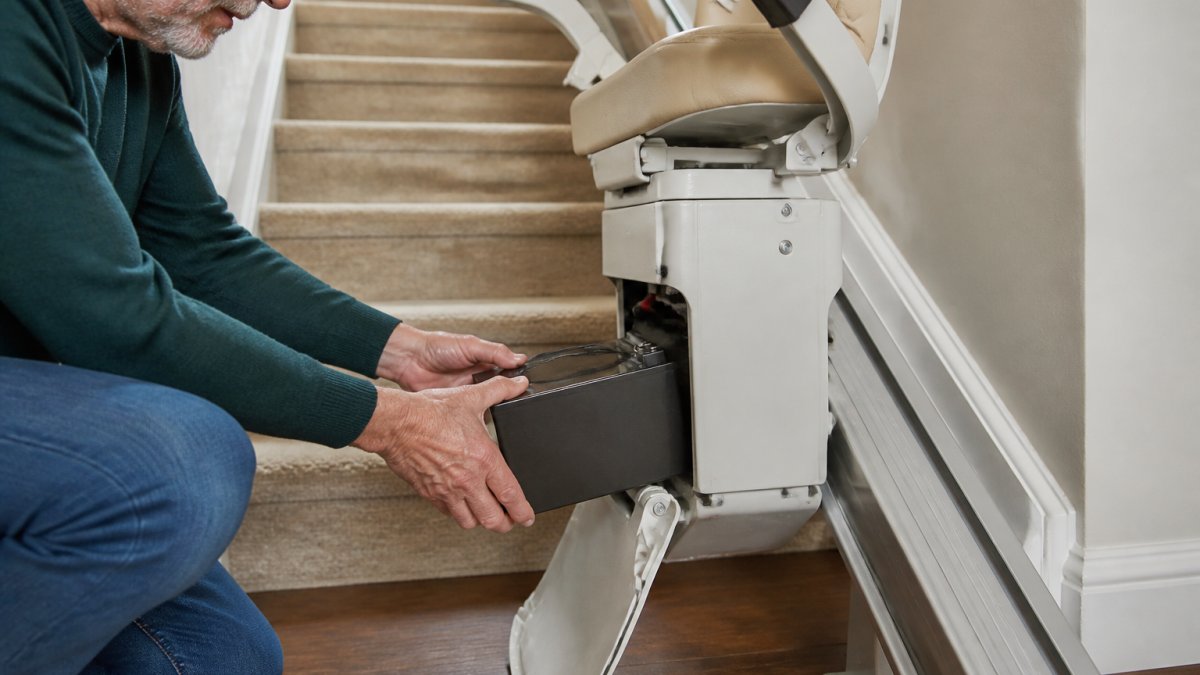
- Most models use sealed lead-acid or lithium batteries, and most manufacturers rate them for several years of normal use before replacement.
- The battery is sized for a number of trips on a full charge, not for indefinite operation. Short outages are rarely a problem; extended outages will eventually drain it.
What Happens During an Outage
During a short outage, the lift behaves normally until the charge drops. In longer outages it stops once the battery drains and recharges when power returns.
If outages are frequent, ask the installer how many trips the model provides on a full charge and whether a second charging point at the opposite end of the rail is available, useful if the lift is often parked at the top.
If the Lift Is Not Charging
A lift that stops charging is usually a simple issue, not a failed system. Work through these in order:
- Confirm the outlet has power. Plug in a lamp or use a receptacle tester.
- Check that the carriage is fully parked at the charging point. If it stopped a few inches short, the contacts may not be touching.
- Inspect the charging contacts on the rail and carriage. Dust, pet hair, or a bent contact can interrupt charging. Wipe them with a dry cloth.
- Check the breaker. If the outlet shares a circuit that tripped, reset it and see whether the lift resumes charging.
- Look for a fault indicator. Most models have a light or display that signals a charging fault. Note what it shows before calling for service.
If none of these resolves it, call the installer or manufacturer. Do not open the battery compartment unless the manufacturer's instructions explicitly allow it.
Day-to-Day Habits That Extend Battery Life
- Leave the lift parked at a charging point when not in use.
- Keep the charging cord and contacts clean and dry.
- Avoid leaving the lift parked mid-rail for long periods, where it cannot charge.
If you are choosing between models and outages are a concern, ask two questions before you buy: how many trips does the battery provide on a full charge, and does the model support charging at both ends of the rail? The answers vary more than most buyers expect.
For anyone worried about being stranded halfway up the stairs, this battery design is the answer. The lift does not depend on the grid to move, but it does depend on a working outlet, clean contacts, and a healthy battery.
Conclusion
The electrical side of a stairlift is far less complicated than most people fear. With a working outlet near your staircase, you are likely ready to go; if not, a small fix usually solves it.
CT Stairlifts handles the whole process, from checking your setup to a clean installation that fits your staircase.
Get started with CT Stairlifts and move safely between floors again.
Frequently Asked Questions
Do stairlifts need a dedicated electrical circuit?
No, most stairlifts do not require a dedicated circuit. They draw very little power and can share an existing household circuit. A dedicated circuit is only needed if the circuit is already overloaded or if local code requires it. A qualified electrician can assess your electrical panel and confirm whether your current setup is sufficient for safe operation.
Can a stairlift plug into a regular household outlet?
Yes, stairlifts are designed to plug into a standard 120V grounded household outlet. The charging cord is typically low-profile and can be routed along the baseboard or under the rail to keep it out of the way. If no outlet exists near the stairs, an electrician may need to add one, but that is usually a minor job and not a full electrical upgrade.
How much electricity does a stairlift use?
Stairlifts consume very little electricity. The motor only draws power while the lift is moving, and the charging station maintains the battery with a trickle charge. Over a year, the energy use is comparable to a small household appliance. You will not see a noticeable increase in your electricity bill from operating a stairlift.
What electrical work might be needed before stairlift installation?
In most cases, no electrical work is needed beyond having a working grounded outlet near the staircase. If the outlet is missing, ungrounded, or on an overloaded circuit, a licensed electrician may need to install a new outlet or make minor repairs. An electrical assessment before installation can identify any issues and ensure everything is ready for a safe install.