 comparison
Do Slim Profile Stairlifts Fit Small Homes?
Last Updated: November 5, 2026
Quick Summary
A slim profile stairlift often fits small homes, but fit depends on three measurements: stair width, folded rail projection, and landing clearance. Measure your staircase at its narrowest point and subtract the folded rail projection to find your usable walking width.
- Measure tread width at the top, middle, and bottom of the run and use the smallest number.
- Landings and door swings sink more installs than narrow treads do.
- The Handicare 1100 is cited for its compact folded profile on tight stairs.
- The Harmar Pinnacle SL600 offers a compact rail and 350 lb capacity but is straight-only.
- Curved staircases need a custom rail, which narrows your model options.
Table of Contents
- Quick Comparison: Slim Profile Stairlift Models at a Glance
- How to Measure Your Staircase for a Stairlift for Narrow Stairs
- Stairlift Folded Width: What It Means for Usable Stair Space
- Compact Models Reviewed: Harmar, Bruno, and Handicare
- Stairlift Installation Requirements for Tight Spaces
- Stairlift Cost With Installation: What Affects the Total
- Straight vs. Curved Stairs: Which Slim Stairlift Fits Your Layout
- Schedule Your In-Home Fit Assessment
- Frequently Asked Questions
Quick Comparison: Slim Profile Stairlift Models at a Glance
A slim profile stairlift can be the difference between staying in the home you love and moving because the staircase no longer works.
The short answer is often yes, but the details matter.
Below, we break down the compact models worth comparing, how to measure your stairs yourself, and what installation and cost really involve. First, here is the at-a-glance view.
| Model | Style | Known For | Stair Type | Pricing |
|---|---|---|---|---|
| Harmar Pinnacle SL600 | Straight | Compact rail, 350 lb capacity | Straight only | Contact for pricing |
| Harmar Pinnacle SL300 | Straight | Entry-level Harmar model | Straight (confirm specs) | Contact for pricing |
| Bruno Elite Series | Straight or curved | Slim-profile home lift | Both | Contact for pricing |
| Handicare 1100 | Straight | Compact folded profile | Straight | Contact for pricing |
| CT Stairlifts install | Straight and curved | Local fit assessment and install | Both | Free home assessment |
How to Measure Your Staircase for a Stairlift for Narrow Stairs
Measure your staircase at its narrowest point, from the wall to the edge of the tread, then subtract the folded rail projection. That number is your usable walking width, and it is the figure that decides whether a stairlift fits.
Here is the practical method we walk homeowners through before any install:
- Measure the tread width at the top, middle, and bottom of the run. Use the smallest number.
- Note where the rail will sit. On most straight stairs it mounts to the treads or the wall side, which eats into width.
- Check the top and bottom landings. You need room to step off and fold the seat away.
If you are unsure whether your staircase qualifies, our guide on whether stairlifts fit narrow stairs walks through the same measurements with photos and examples.
Width, Landing Space, and Obstructions to Check
Width gets all the attention, but landings sink more installs than narrow treads do. A folding seat needs somewhere to fold into at the top, and a swivel seat needs a little room to rotate you toward the landing. Doorways that open onto the bottom step are another common snag. None of these are dealbreakers, but they change which model and rail placement we recommend.
Stairlift Folded Width: What It Means for Usable Stair Space
Folded width is the space the lift takes up when the seat, arms, and footrest are folded away, and it is the number that determines how much of your staircase other people can still use.
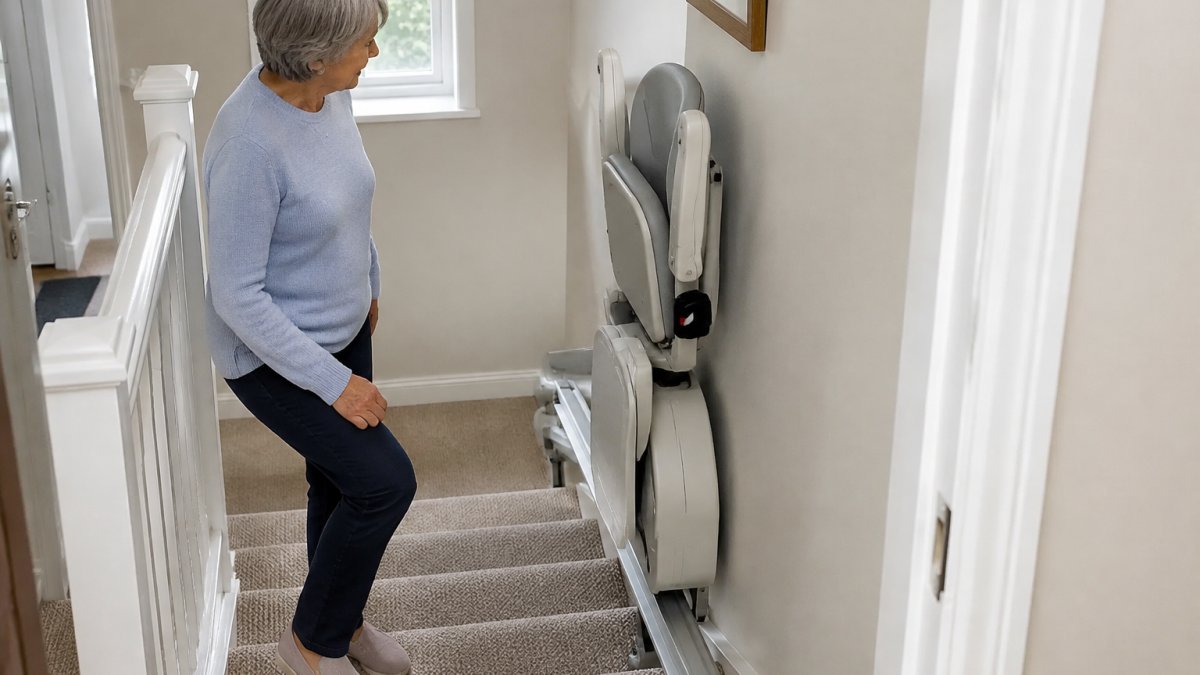
The Handicare 1100 is cited for its compact folded profile, which helps preserve clearance on tight stairs. For a deeper look at fitting and clearance, our narrow-stairs installation guide covers rail placement and folded dimensions in detail.
Compact Models Reviewed: Harmar, Bruno, and Handicare
Three manufacturers dominate the slim-profile conversation, and each takes a slightly different approach to tight spaces. The table below compares the models on the specifications that actually decide whether a lift works on a narrow staircase: folded width, rail projection, weight capacity, and stair configuration. Where a manufacturer does not publish a figure, the cell says so rather than guessing.
| Model | Stair type | Published weight capacity | Folded profile (seat, arms, footrest stowed) | Rail projection from wall or tread | Notable fit notes |
|---|---|---|---|---|---|
| Harmar Pinnacle SL600 | Straight only | 350 lb | Compact rail; confirm folded seat and footrest dimensions with installer | Slim rail; confirm projection for your tread depth | Lightweight, common pick for standard straight runs |
| Harmar Pinnacle SL300 | Straight (confirm) | Confirm with installer | Not published in reviewed material | Not published in reviewed material | Entry-level Harmar model; specs thin, verify before committing |
| Bruno Elite Series | Straight or curved | Confirm model-specific capacity | Slim-profile home lift; folded dimensions vary by seat option | Varies by rail and configuration | Flexible pick when stairs bend or land on a platform |
| Handicare 1100 | Straight | Confirm model-specific capacity | Cited for compact folded profile | Compact rail; confirm projection | Preserves stair clearance when parked |
How to read this table. Folded profile is the number that matters most on a narrow staircase, because it determines how much walkable width remains when the lift is parked.
Harmar Pinnacle SL600 and SL300
The Pinnacle SL600 is the straight-stair workhorse of the group. It is described as a lightweight option with a compact rail and a 350-pound capacity, which suits most homeowners. The SL300 is a named Harmar model, but published specifications are thin, so confirm rail dimensions and capacity with your installer before committing. Watch out: neither model is designed for curved stairs, so a winding staircase rules them out.
Bruno Elite Series and Handicare 1100
The Bruno Elite Series is characterized as a slim-profile choice for home use and is available for both straight and curved configurations, which makes it the flexible pick when your stairs bend. The Handicare 1100 earns its place on folded profile, keeping more of the stair clear when parked. Neither manufacturer publishes folded dimensions in the material we reviewed, so a fit assessment is the only reliable way to confirm clearance in your home.
What the table does not tell you
Specifications are a starting point, not a verdict. A model with a narrow folded profile can still fail on your stairs if the top landing is too short for the seat to swivel, or if a door swing blocks the bottom step. That is why the comparison above should be paired with the measurement method in the next section and with an in-home assessment before you choose.
Stairlift Installation Requirements for Tight Spaces
Installation on a narrow staircase is mostly about rail placement. Stairlift installers generally check the stair pitch and length of the run, the wall structure for anchoring, nearby power, and clearance at both landings for the seat to fold and swivel. Confirm the installation process and timing directly with CT Stairlifts.
Stairlift Cost With Installation: What Affects the Total
Many stairlift pages stop at a quote request, which does not help when you are trying to budget. The honest answer is that a slim-profile stairlift has four cost layers, equipment, installation, optional features, and ongoing ownership, and each one moves independently. Below is how each layer works so you can compare quotes fairly instead of comparing a single bottom-line number.
Layer 1: Equipment (purchase vs. rental)
Straight-stair lifts are standardized, so they are the least expensive equipment category and the easiest to rent. Curved lifts use a custom rail fabricated to your staircase, which raises equipment cost and usually rules out rental. Rental can make sense when the need is short-term (recovery from surgery, a temporary mobility change) because it avoids a large upfront equipment charge; purchase makes more sense when the lift will be in place for years.
Layer 2: Installation
Installation cost tracks complexity, not staircase width. A straight run on a standard pitch with a nearby outlet is the simplest install and is often completed in a single visit. Curved stairs need a custom rail, a longer fabrication lead time, and more installation labor. Factors that raise installation cost include:
- Custom rail fabrication for curves, winders, or platforms
- Rail length beyond a standard run
- Electrical work if no outlet is near the top or bottom landing
- Structural anchoring changes if wall studs are not where the rail needs them
Layer 3: Optional features
Powered swivel seats, powered folding footrests, and upgraded upholstery add to the total. On a narrow staircase, a powered folding footrest is sometimes worth the extra cost because it lets the user stow the footrest without bending, which keeps the folded footprint tight and the stair clear.
Layer 4: Ongoing ownership costs
This is the layer most quotes omit. Budget for:
- Servicing, annual or biannual inspection and lubrication; ask whether the first year is included.
- Batteries, most straight lifts run on rechargeable batteries that need replacement every few years; confirm the replacement cost and whether it is covered.
- Warranty, compare what is covered (motor, rail, seat, labor) and for how long; a longer warranty can offset a higher purchase price.
- Modifications, if you later remodel the staircase or move the lift, rail changes and reinstallation are billable.
How to compare quotes
When comparing quotes, ask for a written breakdown that separates equipment, installation, optional features, and servicing, so the components are easy to compare. For a detailed breakdown of what narrow-stair installs involve, see our guide on what installing stairlifts on narrow stairs costs.
Straight vs. Curved Stairs: Which Slim Stairlift Fits Your Layout
Straight staircases generally accept the widest range of slim-profile models. Curved staircases need a lift built for a custom rail, which narrows the options. Confirm which models CT Stairlifts can supply for your staircase.
The deciding factor is the shape of the run, not the width. Our straight versus curved stairlift comparison breaks down the trade-offs if you are still deciding.
Schedule Your In-Home Fit Assessment
The only way to know for certain that a slim profile stairlift fits your home is to have someone measure it. Guessing from photos or manufacturer specs leaves too much to chance, especially on an oddly shaped or narrow staircase.
CT Stairlifts provides stairlift installations designed to help you regain access to every floor of your home. If you are ready to confirm fit and regain access to every floor of your home, book a free in-home assessment and we will walk your staircase with you.
Frequently Asked Questions
Can a stairlift be installed on narrow stairs?
Yes, in many cases. Slim profile stairlift models are built with compact rails and folding seats, arms, and footrests that reduce how much of the staircase they occupy. The deciding factor is usually the usable stair width after the rail is mounted, not the total width alone. A professional in-home assessment measures your staircase and confirms whether a specific model fits. Homes with very tight turns or landings may need a different configuration or a custom rail.
What is the narrowest stairlift available?
There is no single published minimum width that applies to every model, so the honest answer is that it depends on the specific unit and how it is mounted. Compact straight-stair models are designed for narrow spaces, but folded dimensions vary by manufacturer and model. Ask an installer to confirm the folded width and rail projection for the exact model you are considering.
How much space does a stairlift need on a staircase?
A stairlift needs enough clear width for the rail, the folded seat and arms, and the footrest when stowed. It also needs landing space at the top and bottom so you can sit down, swivel, and step off safely. Because folded dimensions vary by model, the practical approach is to measure your staircase's clear width at its narrowest point and compare it against the manufacturer's folded specifications. An in-home assessment is the reliable way to confirm fit.
How much does a stairlift cost with installation?
Pricing for a stairlift cost with installation depends on the model, whether the staircase is straight or curved, and the work required to fit the rail. Straight-stair installations are generally simpler than curved ones, which need a custom rail. Because CT Stairlifts has not published pricing, contact the company directly for a quote based on your staircase and chosen model rather than relying on a generic figure.
Are stairlifts worth the money compared with moving to a one-story home?
That depends on your circumstances. A stairlift lets you keep access to every floor of the home you already live in, which avoids the cost and disruption of moving. For someone who plans to stay put and age in place, it can be the more practical choice. Compare the installed cost against the expense of relocating, and discuss your long-term mobility needs with an installer before deciding.
A narrow staircase does not have to stand between you and the rest of your home. The right compact model, measured and installed correctly, keeps every floor accessible while leaving room for everyone else to use the stairs too. Get started with CT Stairlifts and find out exactly which slim-profile lift fits your staircase.