 listicle
Best Stairlift for Curved Stairs: 2026 Top Picks & Costs
Table of Contents
- What Makes a Stairlift Suitable for Curved Stairs?
- Top Stairlifts for Curved Stairs: Comparison Table
- 1. CT Stairlifts: Custom Solutions for Complex Staircases
- 2. Bruno Elite Curved: Premium Comfort and Customization
- 3. Handicare Freecurve: Sleek Design for Narrow Spaces
- 4. Harmar Helix Curved: Heavy-Duty Reliability
- 5. AmeriGlide Curved Stairlift: Budget-Friendly Custom Fit
- The Stairlift Installation Process Explained for Curved Stairs
- Frequently Asked Questions
Last Updated: September 16, 2026

What Makes a Stairlift Suitable for Curved Stairs?
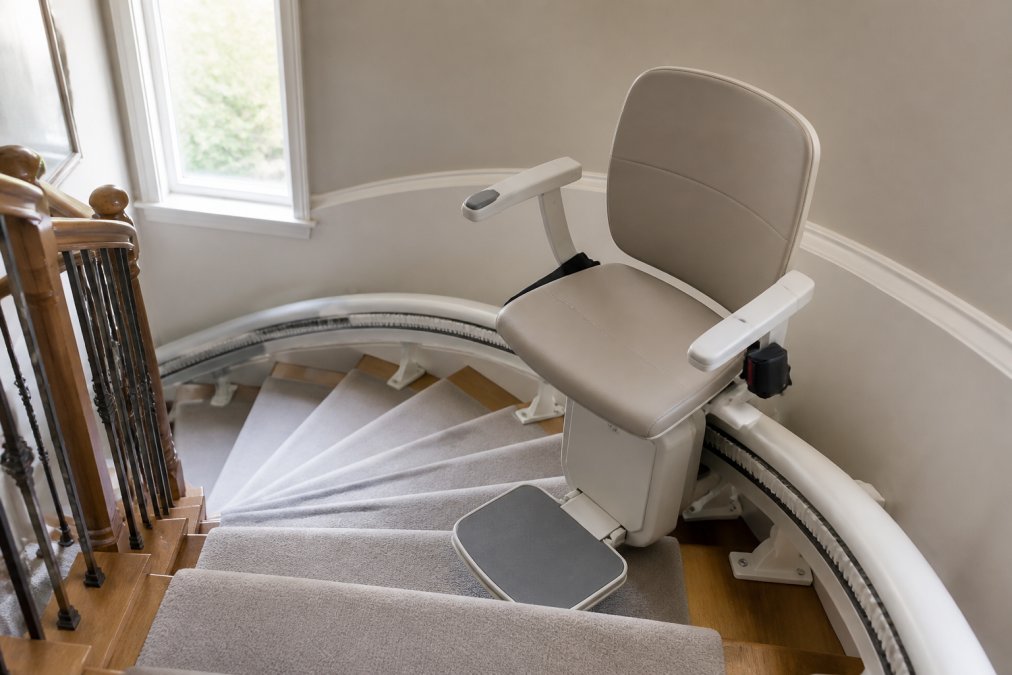
The best stairlift for curved stairs is a mobility aid built around a custom-fabricated rail that follows the exact geometry of one specific staircase, including turns, intermediate landings, and changes in pitch. Unlike straight-rail models, a curved stairlift cannot be bought off a shelf. The rail is measured, fabricated, and installed to match a single set of stairs, which is why two neighbors with similar-looking staircases can receive quotes that differ by thousands of dollars. (Source: ADA guidelines for accessibility)
The four measurements that actually determine fit
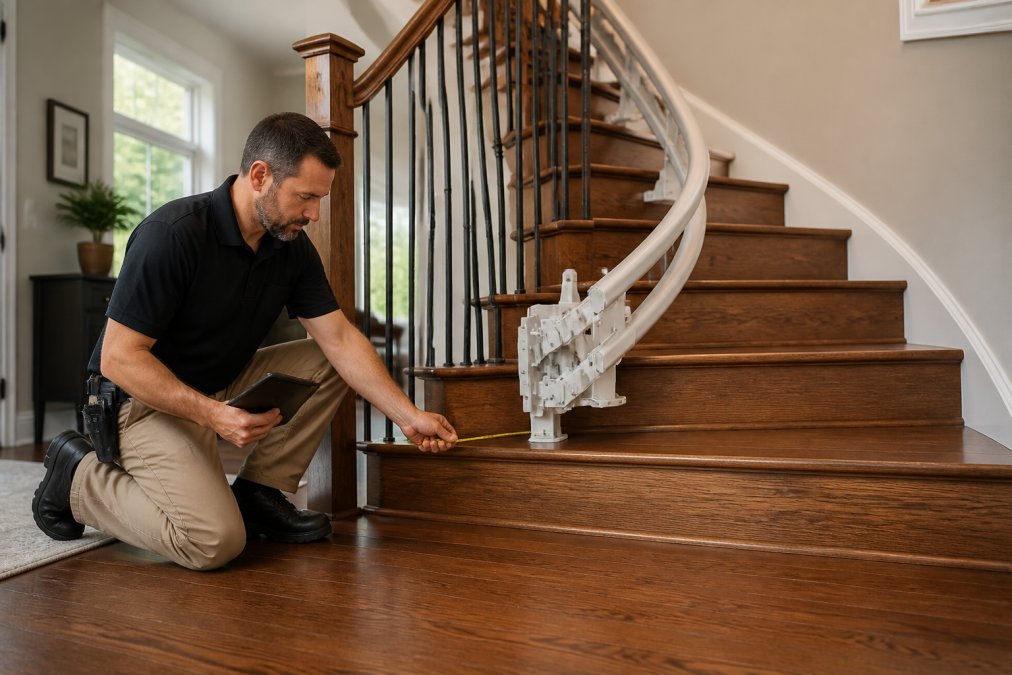
Before a single part is ordered, a survey technician captures four numbers that decide whether a modular system can be adapted or a fully custom rail is required:
- Overall run and rise. The total horizontal distance and vertical height from the bottom landing to the top landing. This sets the rail length and the motor's duty cycle.
- Pitch (angle of incline). Measured in degrees at each straight section. A staircase that changes pitch mid-run, common in older homes with a mid-landing, needs a rail that bends in two planes.
- Turn radius and landing depth. A single gentle bend can often be handled with a modular curved rail. Two or more turns, or a 90-degree landing with less than about 30 inches of depth, typically pushes the job into full custom fabrication.
- Obstruction envelope. The clear width of the tread, the position of any banister or newel post, and the headroom above the top landing. A foldable footrest and a compact carriage keep the stairway usable for everyone else in the house.
When a modular rail works and when it does not
A common pattern installers describe: staircases with one continuous curve and no intermediate landing can sometimes be fitted with a modular curved rail, which shortens the lead time and lowers the price. Staircases with a mid-landing, a switchback, or a spiral geometry almost always require a custom-bent rail fabricated to the survey measurements. If a quote arrives without an in-home survey, treat it as a placeholder, not a price.
A quick self-assessment before you call anyone
You can narrow down your own situation in about ten minutes with a tape measure and a level:
- Count the number of turns between floors. Zero or one is simple; two or more is complex.
- Note whether there is an intermediate landing. Landings force a rail break and add cost.
- Measure the clear width of the narrowest tread. Under roughly 30 inches, a slim single-tube rail becomes important.
- Check the top landing depth. If there is not enough room to stand and dismount clear of the top step, a powered swivel seat is effectively mandatory.
- Look for obstructions: radiators, door swings, or a banister that protrudes into the stairwell.
User requirements that matter more than brand
Weight capacity, seat width, and an ergonomic design matched to the rider matter more than brand names. Standard residential units typically support 300 to 350 lbs, while heavy-duty models reach 400 lbs or more. Seat width and the height of the armrests relative to the rider's frame determine comfort on a long staircase, and a powered swivel seat makes the top landing far safer for anyone with limited mobility.
Top Stairlifts for Curved Stairs: Comparison Table
The table below summarizes the leading curved stairlift options, their starting prices where published, and who each one suits best. Pricing for custom installations depends on staircase complexity, so treat listed figures as entry points only.
| Model | Starting Price | Weight Capacity | Best For | Standout Feature |
|---|---|---|---|---|
| CT Stairlifts | Custom quote | Varies by model | Complex staircases and local support | Specialized installation for every floor |
| Bruno Elite Curved | Contact for pricing | Up to 400 lbs | Premium comfort | Custom-built rail system |
| Handicare Freecurve | $12,500 | Standard residential | Narrow staircases | Single-tube rail design |
| Harmar Helix Curved | $8,000 | Heavy-duty | Multi-level and spiral stairs | Tight radius turns |
| AmeriGlide Curved | $7,599 | Standard residential | Budget-conscious buyers | Custom-fit rails |
1. CT Stairlifts: Custom Solutions for Complex Staircases
CT Stairlifts provides solutions designed to help individuals regain access to every floor of their home, with specialized installation tailored to ensure navigating your home remains safe and convenient. The company focuses on helping homeowners regain access to every floor of their home, and its services are tailored to keep navigating your home safe and convenient.
2. Bruno Elite Curved: Premium Comfort and Customization
Bruno's Elite Curved earns its reputation on ride quality. The American-made unit uses soft start and stop technology, which removes the jolt some riders find unnerving, and its weight capacity reaches 400 lbs. Indoor and outdoor models are both available.

3. Handicare Freecurve: Sleek Design for Narrow Spaces
If your staircase is narrow, the Freecurve's single-tube rail is the reason to shortlist it. The slim profile takes up less room on the steps, and the powered swivel seat and footrest options make mounting and dismounting easier at the top landing.
4. Harmar Helix Curved: Heavy-Duty Reliability
Harmar builds for durability. The Helix handles tight radius turns efficiently and includes continuous charge technology, so the battery stays topped up between trips. Adjustable seat height and width accommodate a range of riders, and safety sensors on the carriage stop the unit if it meets an obstruction.
5. AmeriGlide Curved Stairlift: Budget-Friendly Custom Fit
AmeriGlide is the lowest published entry point on this list at $7,599. Each rail is custom-built to specific staircase measurements, and the package includes safety sensors, a seat belt, and remote control operation. The motor runs quietly, which matters in open-plan homes.
The Stairlift Installation Process Explained for Curved Stairs
The installation process for a curved stairlift follows five stages, and the first one happens before anything is ordered. The whole sequence typically involves several stages from survey to handover, with the fabrication wait accounting for a significant portion of that time.
- In-home survey. A technician measures staircase pitch, rail geometry, landings, and obstructions. This takes roughly an hour. Expect the surveyor to photograph the staircase, note the position of any banister or newel post, and check the top landing for dismount clearance.
- Rail fabrication. The custom rail is manufactured to those measurements. This is the longest wait, often several weeks. A single-bend rail may ship faster than a multi-landing rail, but both are built to order.
- Track installation. The rail is mounted to the treads, not the wall, using brackets positioned to avoid tripping hazards. Mounting to the treads is what allows the rail to follow the staircase's pitch and turns without relying on wall studs that may not exist where you need them.
- Carriage and seat fitting. The chair is attached, and the power swivel seat, safety belt, and obstruction sensors are tested. The technician will run the carriage up and down the full rail several times to confirm the limit switches stop it correctly at both ends.
- Handover. You ride it with the technician present, and the maintenance schedule and warranty coverage are explained. Ask for the serial number and the warranty terms in writing before the technician leaves.
What happens to your staircase during the install
One detail worth knowing: the stairway usually stays usable during installation because the rail mounts close to the wall and the carriage is added last. Most families keep using their stairs throughout the process, though the final day of fitting may block one side for a few hours.
Power, battery, and what to plan for
Curved units run on household current and keep a battery charged for use during a power outage. The charger draws very little, comparable to a small appliance, so no dedicated circuit is normally required. Confirm with the installer where the charging point will sit, because it needs to be reachable without stepping over the rail.
Long-term cost of ownership
The purchase price is not the whole cost. Budget for the following on an annual basis:
- Routine service. An annual inspection and lubrication visit is the common pattern, and many warranties require it to stay valid.
- Battery replacement. The backup battery typically needs replacement every few years, and the interval depends on how often the lift is used and how warm the installation space stays.
- Service contracts. Some owners prepay for an annual plan that bundles the inspection, priority callouts, and parts discounts. Others pay per visit. Ask for both numbers before you decide.
- Rail and carriage wear parts. Rollers and the drive mechanism are the components most likely to need attention over a long service life.
Financing, insurance, and tax treatment
Medicare generally does not cover stairlifts because they are considered home modifications rather than durable medical equipment, and Medicaid rules vary by state. Private insurance sometimes covers a portion if a physician documents medical necessity, so it is worth a call to your plan before you sign. Separately, a stairlift installed for medical reasons may qualify as a deductible medical expense on federal taxes when prescribed by a doctor; keep the prescription and receipts.
Frequently Asked Questions
What kind of stairlift is suitable for a curved staircase?
Curved staircases require a custom-built stairlift with a rail that matches the exact bends, landings, and pitch of your stairs. Unlike straight stairlifts, curved models are made to measure. Look for features like a power swivel seat, obstruction sensors, and battery backup. A professional assessment ensures the lift fits your specific staircase configuration.
How does the installation process differ for curved versus straight stairlifts?
Curved stairlift installation is more involved because the rail must be custom-fabricated after a precise home survey. The process typically includes an in-home measurement, custom manufacturing, and a professional installation. For curved stairs, expect a longer timeline from order to completion compared to straight stairlifts.
What is the average cost difference between straight and curved stairlift models?
Curved stairlifts generally cost more than straight models due to custom rail fabrication and complex installation. While straight stairlifts may have a different cost structure, curved models typically involve custom fabrication and installation, which influences pricing depending on staircase complexity and features. For an accurate curved stairlift cost estimate, schedule a professional assessment, as pricing varies with rail length, turns, and chosen options.
Are there specific safety standards for curved stairlifts in the home?
Stairlifts sold in the U.S. should meet safety standards such as those from the American Society of Mechanical Engineers (ASME). Key safety features include obstruction sensors, seat belts, swivel seats that lock in place, and battery backup for power outages. Ensure your installer follows local building codes and provides a thorough safety demonstration. Regular maintenance is also important to keep all safety mechanisms working properly.
Can a custom-built rail be installed on any curved staircase?
Most curved staircases can accommodate a custom rail, but factors like narrow width, sharp turns, or structural obstacles may affect feasibility. A professional site survey is essential to determine if a stairlift can be installed safely and effectively. Installers can often design rails that fit tight spaces using single-tube systems or compact models. If your staircase is unusually complex, consult a specialist to explore all options.
Curved staircases are the hardest configuration to fit, and a generic quote will not tell you whether a lift will actually work in your home. CT Stairlifts specializes in exactly this problem, with installation designed to help you regain access to every floor of your home safely and conveniently. If you want a proper assessment before committing to anything, get started with CT Stairlifts and find out what your staircase can accommodate.