 listicle
Best Bathroom Safety Grab Bars for Seniors
Table of Contents
- Best Bathroom Safety Grab Bars for Seniors: What Actually Matters
- Best Shower Grab Bars for Seniors: Straight, Angled, and Hinged Options
- Grab Bars for Seniors Near the Toilet: Placement and Support
- Suction Grab Bars Safety: What They Can and Cannot Do
- Wall-Mounted vs. Adjustable: Weight Capacity and Load Ratings
- Grab Bar Installation Cost and Verification
- ADA Compliance vs. Residential Safety: What the Rules Say
- Frequently Asked Questions
Last Updated: October 13, 2026
Best Bathroom Safety Grab Bars for Seniors: What Actually Matters
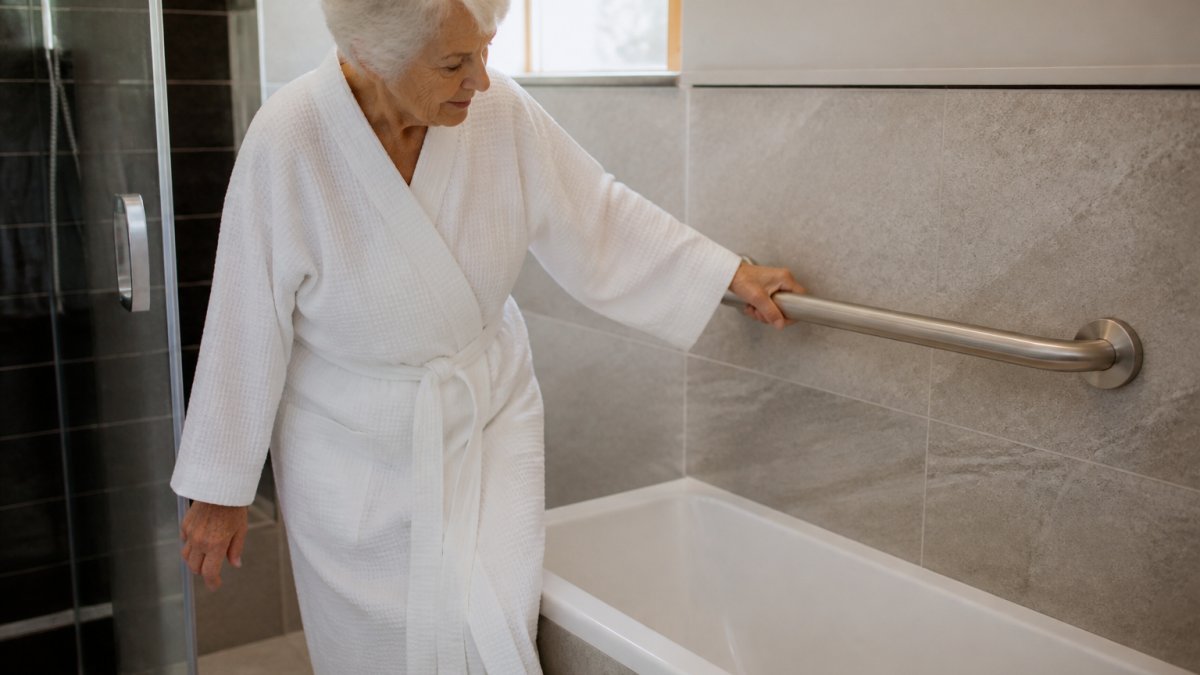
The best bathroom safety grab bars for seniors are wall-mounted stainless steel bars, 18 to 32 inches long, anchored into wall studs and rated to hold at least 250 pounds. Everything else, the finish, the brand, the shape, is secondary to that core specification.
Most falls in the home happen in the bathroom, and grab bars are the single most common fix. We often see the same pattern again and again: the bar itself is rarely the problem. The mounting is.
Below, we break down the shower, toilet, and wall-mounted options worth considering, what suction bars can and cannot do, what installation actually involves, and how to tell whether a bar meets residential safety guidance or the stricter ADA Standards for Accessible Design that apply to public facilities.
| Bar Type | Best For | Anchor Required | Load Rating |
|---|---|---|---|
| Straight, wall-mounted | General support, tub and shower entry | Yes, into studs | 250 lbs+ |
| Angled or hinged | Corner showers, tight layouts | Yes, into studs | 250 lbs+ |
| Suction-mounted | Temporary, travel, renters | No | Low, not for body weight |
| Toilet-side bar | Sit-to-stand transfer | Yes, into studs | 250 lbs+ |
Best Shower Grab Bars for Seniors: Straight, Angled, and Hinged Options
Straight bars are the default choice for most showers because they are the easiest to position and the most affordable. A 24-inch stainless steel bar covers the majority of residential needs.
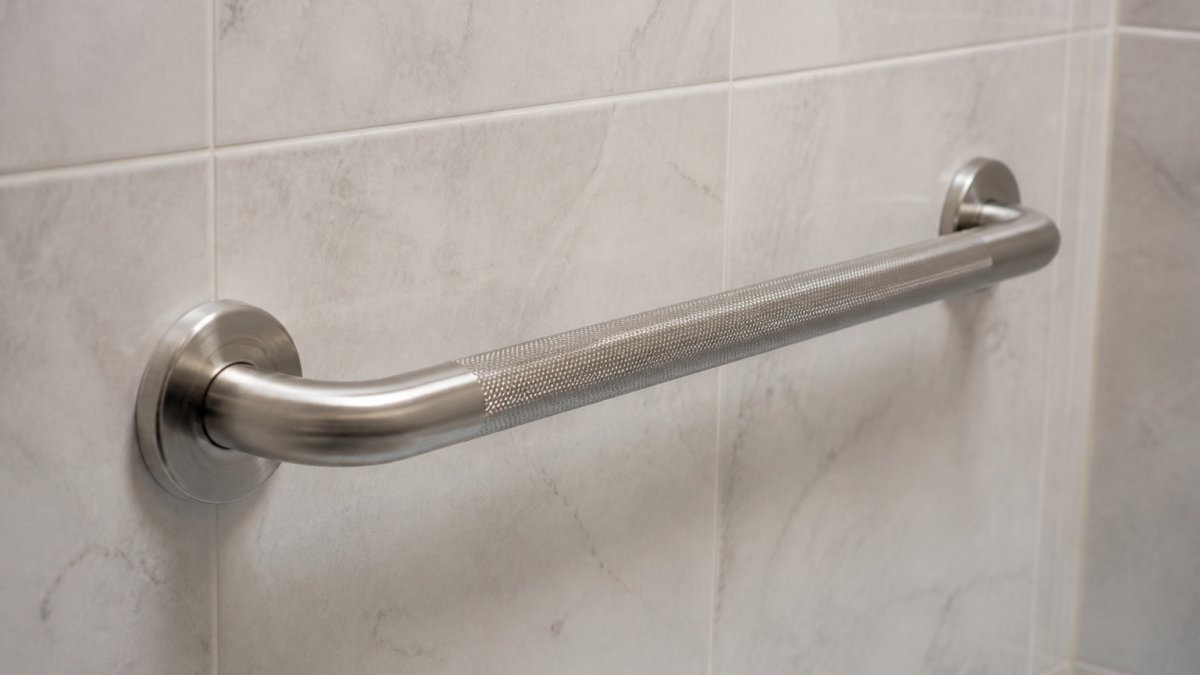
Angled bars add a diagonal section that gives the hand a natural resting point during a slow sit or stand. Hinged bars fold flat against the wall when not in use, which matters in a narrow shower where a fixed bar would clip your shoulder on the way in.
A common mistake is buying a bar that is too short. An 18-inch bar works well next to a toilet but feels cramped in a full-size shower. When in doubt, go longer: a 32-inch bar gives you more room to find a grip without repositioning your feet.
Grab Bars for Seniors Near the Toilet: Placement and Support
Toilet-side grab bars serve a different job than shower bars. They support a sit-to-stand transfer, which means they take a sudden load as the user pushes off, not a steady lean. That changes what you buy and where you put it.
The most useful configuration is a horizontal bar on the side wall, mounted roughly at elbow height when seated, plus an optional vertical bar for pulling forward. A 24-inch bar works for most side-wall placements. If there is no side wall within reach, a floor-to-ceiling security pole is the fallback, though it takes up floor space.
What most guides miss is the toilet paper holder. If it sits where the bar needs to go, move the holder rather than shortening the bar. A bar that ends too soon forces the user to twist and reach, which is exactly the motion that causes falls.
Suction Grab Bars Safety: What They Can and Cannot Do
Suction grab bars are not fall-prevention devices. They are reminder devices. A suction bar can help you steady yourself, but it will release under a sudden load, and a sudden load is what a fall produces.
That distinction matters because suction bars are marketed alongside wall-mounted bars as if they were interchangeable. They are not. The two product families are built for different jobs, and the table below shows where each one belongs.
| Feature | Suction / Temporary Bars | Permanently Mounted Bars |
|---|---|---|
| Attachment | Suction cups or tension clamps | Screws into studs or blocking |
| Load rating | Not rated for body weight | Typically 250 lbs or higher |
| Failure mode | Releases without warning | Deforms or pulls from wall under extreme overload |
| Surface requirements | Smooth, non-porous tile or fiberglass only | Any solid wall with proper anchoring |
| Removal | No tools, no damage | Leaves mounting holes |
| Best use | Travel, brief balance assist, renters who cannot modify the unit | Daily support, transfers, weight-bearing |
A suction bar is reasonable for a renter who needs a temporary handhold for balance while stepping over a tub lip, or for travel. It is not reasonable as the only support for someone with genuine balance loss, and it should never be the primary support at a toilet transfer, where the user pushes off with most of their body weight.
If the surface is not smooth, non-porous tile or fiberglass, a suction bar will not hold at all. Grout lines, natural stone, and textured finishes break the seal. Even on a suitable surface, the seal degrades over time, so a suction bar needs to be re-seated and tested before every use rather than installed once and trusted. (Source: ADA Standards for Accessible Design)
For renters who need real support, the better path is usually a tension-mounted floor-to-ceiling pole, which wedges between floor and ceiling and can carry body weight when installed correctly, or a landlord-approved installation into studs. A tension pole still has limits: it needs a solid ceiling, it takes up floor space, and it must be re-checked periodically for tightness. But it is a genuine weight-bearing option, while a suction bar is not.
Wall-Mounted vs. Adjustable: Weight Capacity and Load Ratings
Wall-mounted bars are the only option that should carry body weight, and their capacity depends entirely on the anchor. A standard grab bar is designed to resist a 250-pound load, but that rating assumes the bar is fastened into structural wood or a proper blocking plate.
The load rating on the box describes the bar, not your wall. Two identical bars, one screwed into a stud and one into hollow drywall with plastic anchors, have wildly different real-world strength. The drywall installation may hold for months and then fail without warning.
Adjustable and portable bars, including tension-mounted poles and clamp-on tub bars, trade strength for flexibility. They can be moved between bathrooms and removed without damage. That flexibility is real, but so is the limitation: they are not anchored to structure, so their capacity is lower and their failure mode is less predictable.
Grab Bar Installation Cost and Verification
Grab bar installation cost depends on the wall, not the bar. A bar itself is often an inexpensive hardware purchase, but the labor to install it correctly varies widely with what is behind the tile.
If a stud sits where the bar needs to go, installation is quick and straightforward. If it does not, the installer has to add blocking, cut into the wall, or use a heavy-duty anchor system, and that adds time and cost. Pricing for any specific job should come from a licensed installer who has seen the wall, so treat any number quoted without an inspection as a rough starting point at best.
Verification is the step most homeowners skip. After installation, test the bar by pulling down and outward with steady, increasing force before trusting it. Then check it again every few months. A bar that has started to move at the mounting plate has already failed, even if it still looks fine.
ADA Compliance vs. Residential Safety: What the Rules Say
ADA compliance applies to public accommodations, not private homes. The ADA Standards for Accessible Design set specific requirements for grab bar diameter, length, spacing, and mounting height in commercial and public facilities. Those standards are a useful reference point, but a private residence is not legally required to meet them.
That distinction matters because it changes what you optimize for. In a public restroom, the goal is a predictable, standardized experience for any user. In your home, the goal is a bar that fits one specific person's reach, height, and mobility. Meeting ADA dimensions is a reasonable starting point, but a bar placed for the average user may not be placed correctly for you.
A common mistake is treating an "ADA compliant" label on a product as proof the installation is safe. The label describes the bar, not the wall it is attached to. A bar that meets every dimensional requirement will still fail if it is anchored into drywall instead of studs or blocking. Compliance and safety are related but not the same thing.
For homeowners, the practical takeaway is a short verification list rather than a code citation:
- Confirm the bar is anchored into structural wood, blocking, or a tested heavy-duty anchor rated for the load, not plastic drywall plugs.
- Check that the mounting height matches the user's reach when seated or standing, not a generic number pulled from a public-facility standard.
- Verify the bar diameter is comfortable to grip. A diameter that is too large for a smaller hand reduces grip security even if it meets a specification.
- Test the finished installation by pulling down and outward with steady, increasing force, then re-check it every few months.
- Confirm the bar is positioned where the user actually reaches during a transfer, which may differ from where a standard drawing places it.
For a personalized assessment, an occupational therapist can evaluate how you actually move in your bathroom and recommend placement based on your transfer needs, not a generic standard. That is the gap most product roundups never mention.
Frequently Asked Questions
Are suction grab bars safe for seniors?
Suction grab bars are generally not recommended as a primary support for seniors. They can lose their grip over time, especially on textured or dirty surfaces, and are not designed to hold a person's full weight during a fall. While they may offer minor balance support for someone with good stability, they should never replace properly installed wall-mounted grab bars for seniors. Always check the manufacturer's weight capacity and inspect the suction cups before each use.
Where should grab bars be placed in a bathroom?
Placement depends on the user's mobility and the bathroom layout. In the shower, install a vertical bar at the entry and a horizontal bar along the back wall. Near the toilet, a bar should be mounted on the side wall or behind the toilet for transfer support. For tubs, an angled bar can help with entry and exit. The goal is to provide a secure grip where balance is most likely to be challenged.
What is the average cost of installing grab bars?
The cost of grab bar installation varies based on the number of bars, wall type, and whether reinforcement is needed. A standard grab bar itself may cost under $50, but professional installation can add to the total. For accurate pricing, contact a qualified installer or contractor who can assess your bathroom's walls and provide a quote. Avoid estimating based on online averages alone, as every installation is different.
How much weight can a bathroom grab bar support?
A properly installed grab bar anchored into wall studs or with appropriate reinforcement can typically support several hundred pounds. However, the actual weight capacity depends on the mounting hardware, wall structure, and installation quality. Always follow the manufacturer's load rating and ensure the bar is attached to solid wood or reinforced blocking, not just drywall. For heavy-duty support, consult a professional installer.
Can grab bars be installed without drilling into tile?
Some grab bars use adhesive or suction mounts to avoid drilling, but these are not as secure as drilled installations. For seniors who need reliable support, drilling into studs or using proper wall anchors is the safest method. If you rent or cannot drill, consider temporary options with the understanding that they have limitations. Always verify the weight capacity and check for stability regularly.