 How-to
How to Troubleshoot Common Stairlift Problems at Home
Quick Summary
Most stairlift problems at home can be checked before calling for help. Start by confirming the key switch is on, the charger is plugged in, the seat is locked in the riding position, and the armrests and footrest are clear. If the lift still will not move, or you notice burning, grinding, or damage, stop and arrange a professional service visit.
- Check the key switch, charger plug and outlet first, and test the outlet with another device.
- Return the swivel seat to the riding position, lower the armrests, and clear the footrest.
- Stop troubleshooting if you smell burning, hear grinding, or see damage to the rail or track.
- Record the number and pattern of beeps and have your model and serial number ready before you call.
- Do not open the control box or bypass a safety switch to silence a beep.
Table of Contents
- Why Your Stairlift Stops Working and When to Act Quickly
- Safety Precautions Before You Start Troubleshooting
- Step-by-Step Checks When Your Stairlift Will Not Move
- What Your Stairlift Beeping Meaning Tells You
- Charging and Battery Checks for Stairlift Faults
- Stairlift Safety Features During Power Outages
- Stairlift Maintenance Checklist to Prevent Repeat Faults
- Booking a Professional Stairlift Service Visit
- Frequently Asked Questions
Stairlift problems at home are common, and some of the simple causes can be checked before you call for help. Knowing the basic checks helps you stay calm and act safely. (Source: Americans with Disabilities Act standards)
This guide walks through the most frequent faults, the safety precautions to follow, and the point where a professional visit is the right call. It explains general checks that apply to most home stairlifts.
Last Updated: November 23, 2026
Why Your Stairlift Stops Working and When to Act Quickly
A stairlift can stop for simple reasons. The most common are a switch left off, an unplugged charger, a flat battery, or a seat that is not in the riding position.
Act quickly if any of these happen:
- The lift stops with someone on it
- You smell burning or see smoke
- The lift makes grinding or unusual noises
If the lift has stopped with someone on it, stay calm and do not try to force the lift to move. Follow the instructions in your user manual, and contact the service provider or emergency services if you cannot get the person safely down.
Safety Precautions Before You Start Troubleshooting
Before you touch any part of the lift, take a few steps to protect yourself and anyone else in the home.
- Make sure no one is sitting on the chair or standing on the stairs
- Keep children and pets away from the rail and the track
- Do not reach into the rail or the moving parts
Stop troubleshooting and call for professional help if you see damage to the rail or track, smell burning, or find exposed wiring. Do not attempt repairs on the motor, the drive system, or the electrical components.
Step-by-Step Checks When Your Stairlift Will Not Move
Work through these checks in order.
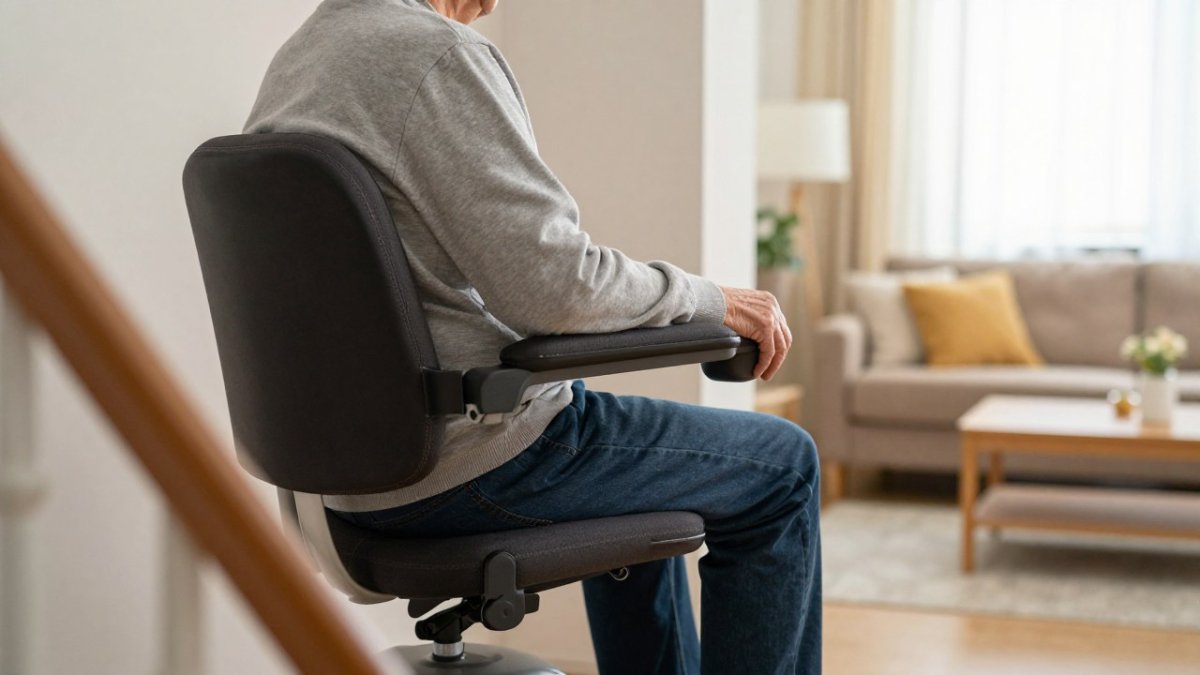
Check the Key Switch, Power Supply and Outlet
- Confirm the key switch is turned on and in the correct position.
- Look at the charger plug. Make sure it is firmly in the wall outlet.
- Test the outlet with another device, such as a lamp, to confirm it has power.
- Check that the charging indicator light is on, if your model has one.
If the outlet is dead, check the circuit breaker or fuse box. Do not use an extension cord unless your user manual allows it.
Return the Seat, Lower the Armrests and Clear the Footrest
- Return the swivel seat to the riding position. Most lifts will not run unless the seat is locked.
- Lower the armrests fully. Many models stop when an armrest is up.
- Fold the footrest down and check that nothing blocks it.
- Remove any objects on the stairs, such as shoes, bags, or tools.
- Check that the safety edges are clear and not pressed against anything.
Then try the up or down button on the armrest control again. If the lift still does not move, the cause may be the battery or a fault covered later in this guide.
What Your Stairlift Beeping Meaning Tells You
A beep is the lift's way of signaling a problem, but the pattern matters more than the sound. Most manufacturers use a distinct sequence for each fault: a single beep, a repeated beep, a beep paired with a flashing light, or a continuous tone. The exact meaning depends on your model, so treat the patterns below as general categories and confirm the specific code in your user manual before you act.
Match the symptom to the likely cause
Work from what you observe rather than from a list of parts. The table below groups the most common symptoms and the checks that usually resolve them.
| What you observe | Likely cause | First checks |
|---|---|---|
| Continuous beep, no movement | Seat not locked, armrest up, or footrest blocked | Return the swivel seat to the riding position, lower both armrests, clear the footrest and safety edges |
| Repeated beeps at the parked position | Charging fault or battery not holding charge | Confirm the lift is parked on the charging contacts, check the charger plug and outlet, look at the charging light |
| Beep plus a flashing warning light | Control or sensor fault | Note the number of flashes, switch the key off and on once, then check the manual for the code |
| Beep only when the lift is mid-rail | Safety edge pressed or obstruction on the track | Remove objects from the stairs, check that the safety edges are not pinched, run the lift slowly in the opposite direction |
| Intermittent beep during a ride | Loose connection or aging battery | Check the charger connection, confirm the battery age, and book a service if the pattern repeats |
Record the pattern before you call
Write down the number of beeps, whether they repeat, and what the lift was doing when they started. A technician can use that record to bring the right part on the first visit instead of diagnosing from scratch.
Watch out: do not open the control box or bypass a safety switch to silence a beep. The beep is often the only warning before a fault becomes a safety problem, and tampering with the controls can void the warranty and leave the lift unsafe to use.
Charging and Battery Checks for Stairlift Faults
Many home stairlifts run on rechargeable batteries that are topped up when the chair is parked at a charging point. A charging problem can look like a dead battery, a control fault, or a power failure. The checks below help you separate those causes before you call for service.
Confirm the lift is actually parked on the charging contacts
The charging contacts are metal strips or pads on the rail and the carriage that only touch when the chair is in its parked position.
- Run the lift to the end of the rail and let it stop on its own.
- Confirm the seat is in the riding position and the armrests are down.
- Look for the charging indicator light on the carriage or the wall charger.
- If the light is off, check that the charger is plugged into a working outlet and that the outlet has power.
Watch out: do not push or drag the chair to force the contacts together. If the chair will not park in the correct position, the limit switch or the rail end stop may need adjustment by a technician.
Tell a charging fault apart from a power or control fault
Use the indicator lights and the behavior of the lift to narrow the cause:
- Charger light off, outlet tested and working: the charger, the charging contacts, or the wiring between them is the likely fault.
- Charger light on, but the lift still runs slowly or stops: the battery may be aging and no longer holding a full charge.
- Lift works normally when parked but fails after a power outage: the backup battery is not holding charge, or the lift was not parked on the contacts long enough to recharge.
Understand battery aging
Stairlift batteries age over time, and capacity typically drops gradually. A sign of an aging battery can be a lift that runs slower, stops partway up the rail, or needs a longer park to recover. If the charging checks pass but the range remains short, the battery may be the cause. You can find out whether a battery backup is necessary and what it involves before deciding on a repair.
When to stop and call for service
Stop troubleshooting and book a visit if the charger or contacts show damage, if the lift smells hot near the carriage, or if the battery does not recover after a full overnight charge at the correct parking position. Have your model and serial number ready, along with the charging light behavior and how long the lift has been in service.
Stairlift Safety Features During Power Outages
Many stairlifts include a backup battery that may keep them working during a power outage. Some models have a manual release or rescue procedure described in the user manual.
Check these points:
- Confirm the battery is charged and the charger is plugged in
- Learn how the lift behaves without mains power
- Know where the manual release is and how it works
- Keep the user manual in an easy-to-find place
If you are unsure how your lift behaves in an outage, ask your service provider to show you the procedure during a visit.
Stairlift Maintenance Checklist to Prevent Repeat Faults
Regular checks can prevent many repeat problems. Use this checklist once a month:
- Clear the stairs and rail of objects
- Check the charger plug and outlet
- Confirm the battery charging light is working
- Test the up and down controls
Keep a record of any faults and the steps you took. This helps you spot patterns and gives a technician useful information.
Booking a Professional Stairlift Service Visit
Call a professional if the basic checks do not fix the problem, or if you notice any safety concern. A trained technician can test the motor, the battery, the sensors, and the electrical system.
When you book a visit, have these details ready:
- Your stairlift model and serial number
- The fault you have seen and when it started
- Any beeps, warning lights, or error numbers
- The steps you have already tried
For current service options and contact details, check the CT Stairlifts website or call the team directly.
Frequently Asked Questions
Why is my stairlift beeping and refusing to move?
A beep with no movement usually means the stairlift has detected a condition it will not override. Common causes include an obstruction on the rail or footrest, a seat or armrest that is not in its locked travel position, or a safety edge that is pressed. Start by clearing the path and checking that the seat is turned to the riding position. If the beeping continues, check your owner's manual for the meaning of the specific sound and indicator light, since codes differ by model. If the problem persists, contact a qualified technician rather than repeating the same attempt.
How do I manually operate a stairlift during a power outage?
Many stairlifts include a battery backup that lets the chair complete a trip during a short outage, but the details depend on the model. Check your user manual for the location of any manual lowering or emergency release control. Do not attempt to force the chair or work on the drive mechanism yourself. If you are stuck on the stairs and cannot safely descend, call emergency services. Once power returns, check the charging indicator and contact your service provider if the battery does not hold its charge.
When should I call a professional for stairlift repairs?
Stop troubleshooting and call a qualified technician if the stairlift shows an error code you cannot clear, if the battery will not charge after you have confirmed the outlet works, if you notice a burning smell, sparking, or damaged wiring, or if the chair stops partway up or down the stairs. Also call for service if the rail is bent, the safety edges are damaged, or a fault returns after a reset. Do not attempt rail or electrical repairs yourself. Ask the technician to explain what was fixed and whether a maintenance schedule is recommended.
What maintenance helps prevent recurring stairlift faults?
Regular checks reduce repeat problems. Keep the rail and track clear of debris, inspect the safety edges and footrest for damage each month, confirm the battery is charging on its normal schedule, and test the up, down and key switch functions. Keep the charger plugged into a working outlet that is not shared with high-draw appliances. Record any beeping or error indicator you see so you can describe it accurately during a service call. For scheduled inspections and parts, contact CT Stairlifts directly for current service options.