 how-to
How to Apply for Stairlift Grants: Step-by-Step
Table of Contents
- Understanding Stairlift Grants and Funding Options
- Free Stairlift Eligibility: Who Qualifies
- Stairlift Grant Application Documents You'll Need
- How to Pay for a Stairlift: Your Complete Application Workflow
- Step 1: Pin Down Your Location and Match It to the Right Program Type
- Step 2: Confirm Eligibility Before You Spend Time on Forms
- Step 3: Get the Occupational Therapy or Clinical Assessment
- Step 4: Assemble the Document Packet
- Step 5: Submit and Track Your Application
- Step 6: Respond Fast to Requests and Prepare for Approval
- Types of Stairlift Grants and Funding Programs
- What Happens After Approval: Installation, Appeals, and Next Steps
- Common Mistakes to Avoid When Applying for Stairlift Funding
- Frequently Asked Questions
Last Updated: October 7, 2026
Understanding Stairlift Grants and Funding Options
Stairlift grants are financial assistance programs that help pay for installing a stairlift at home.
Eligibility depends on age, income, disability status, and veteran status. Some programs cover the full cost, others part of it, and a few offer tax breaks instead of direct funding.
Multiple funding paths exist, so you don't have to pay out of pocket alone.
Free Stairlift Eligibility: Who Qualifies
Not everyone qualifies for free or subsidized stairlifts. Eligibility rules vary by program.
Veterans and VA Grants for Stairlifts
SAH grants are larger and cover major modifications, including stairlifts; SHA grants are smaller but still help with accessibility equipment (Disability Housing Grants For Veterans).
The VA requires a medical assessment from a VA healthcare provider confirming the stairlift is medically necessary. If approved, the VA pays the installation company directly.
Medicaid and State Assistance Programs
Medicaid covers stairlifts in many states, but only if a doctor prescribes it as medically necessary. Coverage varies: some states cover the full cost, others part of it, and a few don't cover stairlifts at all.
To qualify for Medicaid coverage:
- You must meet income and asset limits
- A doctor must document medical necessity
- You typically need prior authorization before purchase
Contact your state Medicaid office about coverage; rules change annually and eligibility depends on your state's program.
Disabled Facilities Grants and Local Council Support
Local councils in some areas offer Disabled Facilities Grants (DFG), which help homeowners and renters adapt their homes for disabilities.
DFG programs are means-tested, so income and savings affect eligibility. Grant amounts vary: some councils offer full funding, others require a small contribution.
To apply, contact your local council's housing or social services department.
Stairlift Grant Application Documents You'll Need
Most grant programs require similar documentation. Gathering these upfront saves time and prevents delays.
Medical and Occupational Therapy Documentation
Grant programs want proof that you medically need a stairlift. This means paperwork from healthcare providers.
Required medical documents typically include:
- A letter from your doctor stating medical necessity
- Occupational therapist assessment of your home and mobility needs
- Proof of disability or service connection (for VA grants)
An occupational therapist can evaluate your home and recommend specific equipment, documenting why a stairlift is necessary and safe. Many grant programs require this assessment.
Financial and Property Ownership Records
Grant programs check your income and assets. Bring recent financial documents.
You'll typically need:
- Last two years of tax returns
- Recent pay stubs or benefit statements
- Bank and savings account statements
Renters should note: some programs require written landlord consent before installation.
How to Pay for a Stairlift: Your Complete Application Workflow
The application process has clear steps. Following them in order increases your chances of approval and speeds up funding.
Step 1: Pin Down Your Location and Match It to the Right Program Type
Before downloading any form, identify the agency that administers funding where you live. Programs are not portable, a grant in one state, county, or city may not exist in yours, and applying to an unavailable program wastes weeks.
Use this location-first filter:
- Veterans: Start with the U.S. Department of Veterans Affairs (VA). Housing grant programs are administered nationally, but the medical necessity determination runs through your VA healthcare provider and your regional VA office.
- Medicaid enrollees: Start with your state Medicaid agency. Medicaid is a federal-state partnership, so coverage rules, prior authorization forms, and approved vendor lists are set at the state level.
- Older adults and adults with disabilities on limited income: Start with your local Area Agency on Aging (find it through the Eldercare Locator) and your city or county housing or social services department.
Step 2: Confirm Eligibility Before You Spend Time on Forms
Run a quick self-screen against the most common eligibility gates. If you fail any, move to the next program rather than submitting and hoping.
- Medical necessity: Nearly every program requires a licensed healthcare provider to document that a stairlift is medically necessary. A prescription alone is usually not enough, you typically need a letter describing your diagnosis, functional limitations, and why stairs are unsafe.
- Income and assets: Means-tested programs (many state and local home modification grants) look at income, savings, and sometimes home equity. Ask for the current income limit in writing.
- Age or disability status: Some programs are limited to adults 60+, some to people with a documented disability, some to both.
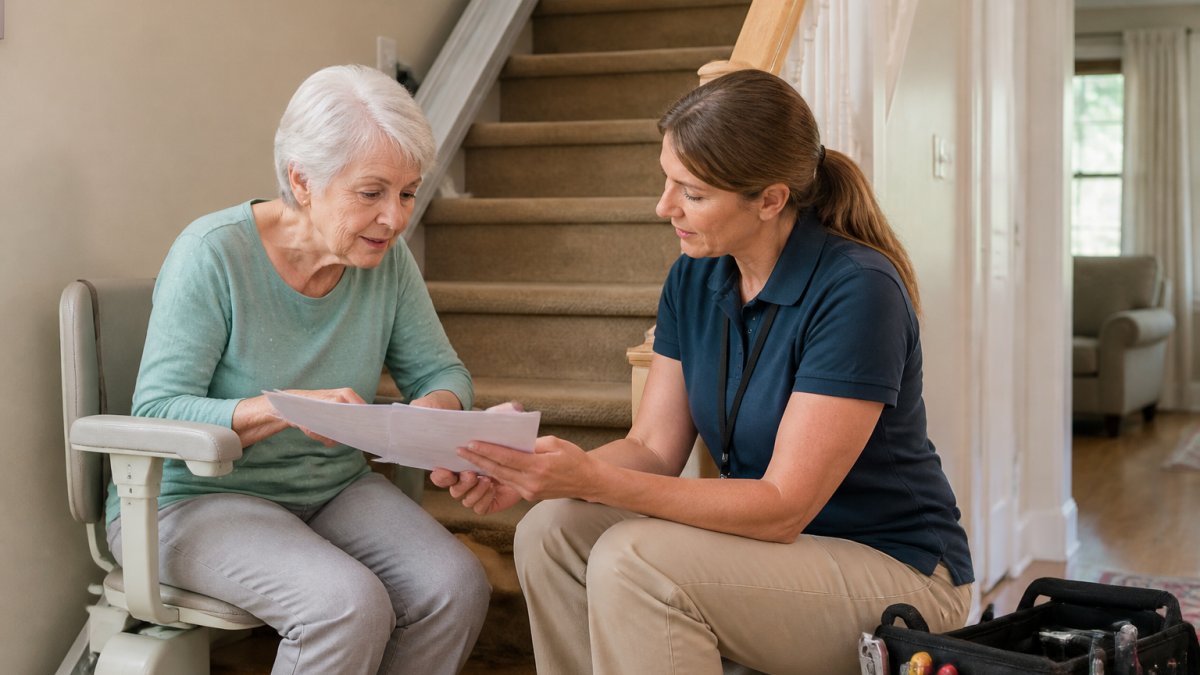
Step 3: Get the Occupational Therapy or Clinical Assessment
Most funding programs will not accept a self-reported need. They want an assessment from a qualified professional, usually an occupational therapist (OT) or, for VA cases, a VA healthcare provider.
What the assessment typically covers:
- Your mobility, balance, and functional limitations on stairs
- The layout of your home and where the stairlift would be installed
- Whether a stairlift (versus a ramp, chair lift, or other modification) is the appropriate and safe solution
Ask the assessing professional to write the report in the language the funding program expects, "medically necessary home modification" rather than general observations.
Step 4: Assemble the Document Packet
Build one master packet, then make program-specific copies. Most programs ask for some combination of the following:
Medical evidence
- Letter of medical necessity from your physician
- Occupational therapy or clinical assessment report
- Relevant medical records or diagnosis documentation
Financial evidence
- Most recent federal tax return (some programs ask for two years)
- Recent pay stubs, Social Security statements, or pension/benefit letters
- Bank and savings account statements
Property and residency evidence
- Proof of homeownership (deed, mortgage statement, or property tax bill) or a copy of your lease
- Written landlord consent if you rent
- Proof of residency in the state, county, or city administering the program
Program-specific forms
- The agency's application form for the current cycle
- Vendor quote or estimate on the vendor's letterhead
- Prior authorization request form (common for Medicaid)
Step 5: Submit and Track Your Application
Follow the submission instructions exactly, online portal, mail, or in-person drop-off. Then treat the application like a case you are managing, not a letter you mailed.
- Keep a full copy of everything you submit, including the signed application and every attachment.
- Note the submission date and, if available, the confirmation or case number.
- Ask for the name and direct contact of the person handling your file.
Processing times vary widely: some local programs decide within weeks, while state Medicaid prior authorization and VA housing grant reviews commonly take longer.
Step 6: Respond Fast to Requests and Prepare for Approval
If the agency asks for more information, respond within its deadline, slow responses are a leading cause of stalled applications. Common follow-ups include clarification of medical necessity, updated income documentation, a revised vendor quote, or an additional provider letter.
When you receive an approval letter, read it line by line. Confirm:
- The approved dollar amount and what it covers (equipment, installation, assessment, permits)
- Whether you must use a specific vendor
- What documentation the agency needs after installation (often an invoice and a completion certificate) (Source: Centers for Medicare & Medicaid Services (CMS))
Types of Stairlift Grants and Funding Programs
Understanding your options helps you choose the best fit.
Federal and Veterans' Assistance
VA Specially Adapted Housing (SAH) grants are the largest federal program for veterans.
VA Special Home Adaptation (SHA) grants are smaller but still substantial, covering smaller modifications and equipment.
Federal Medicaid sets guidelines, but each state runs its own program. Some states cover stairlifts generously.
State and Local Grant Programs
Many states have dedicated home modification programs for seniors and people with disabilities.
Area Agencies on Aging often administer state funding and can tell you what programs exist locally and whether you qualify.
Local councils sometimes offer Disabled Facilities Grants. These are means-tested but don't require repayment. Eligibility and amounts vary by location.
Nonprofit and Community Organizations
Some nonprofits offer grants or low-interest loans for home modifications.
Organizations focused on specific conditions (arthritis, Parkinson's, spinal cord injury) sometimes fund accessibility equipment.
Community development corporations may offer home modification assistance; check with your local housing authority or social services department for leads.
What Happens After Approval: Installation, Appeals, and Next Steps
Approval is exciting, but the process continues. This section covers what to do between approval and installation, how to handle a denial, and how to avoid common post-application problems.
From Approval to Installation
Once you have written approval, confirm the details before scheduling anything.
- Verify the vendor is approved. If your program maintains a vendor list, confirm your installer is on it. Using an unapproved vendor can void the funding.
- Get the final quote in writing. The quote should itemize the stairlift unit, installation labor, any required assessment, permits, and any warranty or service plan.
- Confirm what the grant covers. Some programs pay the vendor directly; others reimburse you after installation. Know which model applies so you are not caught short on cash flow.
Installation is typically a one- to two-day job for a straight staircase and longer for a curved one. Afterward, the program usually requires an invoice and sometimes a signed completion form before releasing payment.
If Your Application Is Denied
Denial happens. It is not the end.
Common denial reasons:
- Insufficient or vague medical documentation
- Income or assets above the program's limit
- Stairlift not deemed medically necessary
Step 1: Get the reason in writing. Call the agency and ask for the specific denial reason and the rule or policy it cites.
Step 2: Identify the appeal path. Ask three questions:
- Is there a formal appeal or reconsideration process?
- What is the deadline to file?
- What evidence can I submit that was not in the original application?
Step 4: File on time. Appeals have hard deadlines. Missing one usually closes the case. Submit in writing and keep proof of delivery.
Alternative Funding If You Are Denied or Waitlisted
Do not stop at one program. Stacking or sequencing funding sources is common.
- Reapply to a different program. A state home modification grant, a local housing program, and a nonprofit may each have separate eligibility rules.
- Ask about low-interest loan programs. Some state housing finance agencies and community development organizations offer below-market home improvement or accessibility loans.
- Check condition-specific nonprofits. Organizations focused on arthritis, Parkinson's, multiple sclerosis, spinal cord injury, and similar conditions sometimes fund accessibility equipment or offer grants.
Protecting Yourself: Scams and Contractor Red Flags
Stairlift funding attracts scammers. Protect yourself with a few simple rules.
- No legitimate grant program asks you to pay a fee to receive a grant. If someone requests an upfront "processing" or "release" fee, walk away.
- No legitimate agency asks for your Social Security number, bank login, or full financial account details by text or unsolicited email.
- Verify the program exists. Call the agency using a number you look up independently, not a number from the email or caller.
After Installation: Keep Your Records
Once the stairlift is installed and the program has paid, keep these together in one file:
- The approval letter and any conditions
- The final invoice and proof of payment
- The installation completion form, if required
You may need them if you apply for additional modifications later, sell the home, or face a post-installation review.
Common Mistakes to Avoid When Applying for Stairlift Funding
Learning from others' mistakes saves time and frustration.
Applying to the wrong program. Confirm eligibility before spending time on an application you don't qualify for.
Submitting incomplete applications. Missing documents delay everything. Double-check the required list. Include everything asked for.
Delaying the application. Waiting means longer waits for approval. Apply as soon as you're ready.
Applying for stairlift grants takes effort, but it's achievable.
Frequently Asked Questions
Who is eligible for a free stairlift?
Eligibility depends on the specific funding program. Veterans may qualify through VA Specially Adapted Housing grants. Medicaid covers stairlifts in many states for eligible individuals. Some states offer Disabled Facilities Grants for homeowners with disabilities. Local Area Agencies on Aging and nonprofit organizations also offer assistance based on age, disability status, and income. Contact your local council or state health department to determine which programs you qualify for.
What documents do I need to apply for a stairlift grant?
Most applications require medical documentation from a healthcare provider confirming your mobility limitations, an occupational therapist's assessment of your home accessibility needs, proof of homeownership or rental agreement, financial statements or tax returns to verify income, and proof of residency. Some programs also ask for quotes from installation companies and details about your home's layout. Check with your specific program for their exact requirements before gathering documents.
Can veterans get financial assistance for a stairlift?
Yes. The VA offers Specially Adapted Housing grants and Special Home Adaptation grants for eligible veterans with service-connected disabilities that affect mobility. The amount available depends on your disability rating and the specific grant program. Contact your local VA regional office or visit VA.gov to determine your eligibility and apply. A VA representative can also help guide you through the application process.
How long does it take to get approved for stairlift assistance?
Processing times vary by program. Some state and local grants take 4-8 weeks, while federal programs like VA assistance may take longer depending on your disability rating review. Medicaid approval timelines differ by state. It's best to apply early and follow up regularly with the administering agency. Ask about expected timelines when you submit your application so you can plan accordingly.